Friday, April 2, 2010

Children of the 90s is Still on Vacation...In the Meantime, Please Enjoy this Classic Post on Super Soakers

Children of the 90s is on vacation...please excuse this interruption from your regularly scheduled nostalgia programming. In the meantime, please enjoy this classic Children of the 90s post from way back when in the blog's early days. Not many people were reading, so you might be seeing it for the first time. How exciting is that? It's like a new post all over again. Almost.

Without further ado, I present this classic post: Super Soakers
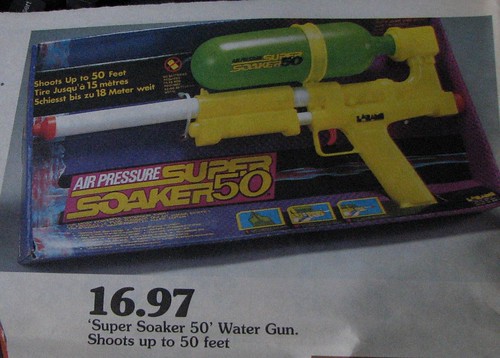


Kids today have it too easy. Forget the value of dedication and hard work that so defined our generation. Their need for instant gratification continuously pushes aside their pioneering spirit of industry and diligence.

That's right, I'm talking about water guns. In our day, we knew the meaning of painstaking commitment to getting the job done. There was none of this "press the trigger and water sprays" nonsense. We would pump those Super Soaker air-pressure chambers until our fingers blistered, but it would all be worth it to spray our friends standing fifty yards away.

Originally christened the "PowerDrencher", Super Soakers burst onto the scene at the tail end of the 1980s. Approaching the 90s, toy water gun producers had fallen upon hard times, garnering flack from all sides on their regrettably realistic renderings of actual weaponry:

(image of Larami Uzi via iSoaker.com)

With parents and lawmakers increasingly conscious of how violent toys and media impacted the impressionable youth of America, these troublingly accurate imposters were on the way out. Water guns needed a new, updated image to distance themselves from their connotations of violence and war. What they needed was a light-hearted, neon-colored remastered water gun prototype with a distinctly non-military name.

At the prime meeting of timing and technology, inventor Lonnie Johnson and toy-maker Larami teamed up to produce a new water gun that fully diverted from the warlike water weapons of the past:


Super Soakers had a distinctly different tone from preceding water guns, and the ad conveys the odd sense of whimsy associated with their product. Though the commercial prominently features the theme of revenge, we can only assume that stereotypical 90's rich girl Buffy really had it coming. Also, who could resist the throwback to the Blues Brothers in their execution of their masterminded pool party-ruining scheme? This is 90s advertising as its finest.

Revolutionary in design, Super Soakers required their wielders to pump pressurized air into a separate chamber on the water gun that would build up the power to shoot water at great distances. While updated models abandoned this arm-exhausting mechanism, a great deal of the fun was contingent on that re-arming period. You felt that you had really earned that shot. You worked hard for it, and the results were spetacular. Plus, there was that awesome water bottle chamber with super-accesible fillability.

Unfortunately, while Super Soakers of today may possess greater power and precision, their R&D department's insistence on churning out novel products have led them to...well, new lows. In an effort to keep this blog in the PG range, I am not going to comment on the following video. Rather, I leave it to you to deduce from it what you will. Let's just say it stirred up quite a bit of controversy among children's advocate groups for its...provacative implications. I'm going to leave it at that.


Check it out:
Super Soaker Evolutionary Family Tree
AV Club Spoof of Hasboro Oozinator Marketing Meeting


Thursday, April 1, 2010

Children of the 90s is on Vacation...In the Meantime, Please Enjoy This Classic Salute Your Shorts Post


Children of the 90s is on vacation...please excuse this interruption from your regularly scheduled nostalgia programming. In the meantime, please enjoy this classic Children of the 90s post from way back when in the blog's early days. Not many people were reading, so you might be seeing it for the first time. How exciting is that? It's like a new post all over again. Almost.

Without further ado, I present this classic post: Salute Your Shorts


Does the name "Zeke the Plumber" still send chills of terror down your spine? Do you still wonder what happened to the buried treasure of ex-counselor Sarah Madre? Do you continue to lose sleep wondering about the appearance and whereabouts of mysterious camp owner, Dr. Kahn? Does the seemingly inocuous phrase "awful waffle" make you wince in pain? Well, you may be a Salute Your Shorts junkie.

Don't worry, though, you're not alone. Many of us children of the 90s suffer a similar affliction. There was a wonderfully effective cure available briefly in the 90s that aired Saturdays at 5:30 p.m. Unfortunately, the treatment is no longer available and those of us still suffering withdrawal are forced to self-medicate with YouTube clips. You can put yourself on the waiting list for long-term treatment (found here), but the outlook isn't good.

In a way, we all grew up at Camp Anwanna. We had all of our favorite standard 90s characters: The hero, the princess, the bully, the new-age oddball, the jock, the nerd, and the butt-of-the-jokes chubby one. They were all under the semi-tyrannical rule of Kevin "Ug" Lee, (get it? Ug Lee? Ugly? Witty, yes?) their authoritarian counselor charged with keeping this wacky mismatched group of campers in line. I went to various summer camps for 14 years, and I don't know a single one of my old camp songs by heart. I do, however, have the uncanny ability to remember all of the lyrics and produce mental screenshots of the Camp Anawanna song:

"We run, we jump, we swim and plaaaay. We row and go on trips
But the things that last foreveeeeeer are our dear friendships.

Camp Anawanna, we hold you in our hearts
And when we think about you--it makes me wanna fart!
--"It's 'I hope we never part'
Now get it right or pay the price!"

Now we will share a lifetime of the fondest memories
By the lake of Anawanna...set in the old pine trees!

Camp Anawanna, we hold you in our hearts
And when we think about you (This thing came apart)


Think Anawannawanna, Speak Anawannawanna, Live Anawannawanna. Ug!"

Here is a clip of the season 2 version of the theme song, which differs from the original in one initially indetectable but extremely significant way:


Seems normal enough, right? You're probably thinking to yourself, why that's exactly how I remember it! Let's do a character run-down and I think you'll see the slight discrepancy to which I was referring:


Bobby Budnick, our charming resident bully. You may be thinking to yourself, how can a guy with a flaming red mullet be a bully? In most other settings, wouldn't he be relentlessly mocked for merely existing with such an unfortunate aesthetic? Yes, but this was summer camp. This was also the nineties, where a mullet and cut-off t-shirts is more than enough to declare your bad-ass status. Budnick was forever playing tricks on his unsuspecting and less antisocial peers, most notably when he told the nightmare-inducing Zeke the Plumber ghost story to the other campers and set up scare traps across Anawanna. Well, he got what was coming to him when they saw him screaming like a girl in those spider webs. Eh? Am I right? Also, Budnick seemed to be a virtual fountain of contraband available for sale to his fellow campers. He was a big fan of the empty thread "...or I'll pound you," in which his mullet and cut-off t-shirt bad-assedness it emphasized by forever unrealized forbodence of pounding (which I am going to hope for all of our sakes is a euphemism for beating someone up.)


Donkeylips, the disgustingly monikered hapless fat kid. He was generally relegated to the role of thankless lackey and sidekick to the aforementioned Mr. Budnick. Donkeylips represented those feelings of insecurity and inadequacy in all of us; his premature cynical outlook and unquenching desire to be liked was certainly recognizable. Oh, and did I mention he was fat? Boy, was he fat! Despite all of those deep character traits, his unfortunate chubbiness was more often than not the major Donkeylips punchline.


Sponge, the smart nerdy one. Like any good 90s show, his intelligence and social ineptitude is characterized by his character's need for glasses. Apparently, popularity was reserved for those of us with superior eyesight. This nebbish little bowl-cutted pipsqueak sometimes veered dangerously close to the Screech zone, but was generally more brainy than irritating. You can also see in the intro that he enjoys science based on his penchant for dressing skeleton models in his own clothing and examining them with a magnifying glass (obviously the correlation between vision-enhancers and nerdiness is deeper-set than we'd originally thought.) They call him Sponge because he absorbs things. Get it? Like a Sponge! Oh, Salute Your Shorts. What zany nicknames will you think of next?


Telly, the girl jock. Yes, a girl jock. How progressive is that? Telly was relatively bright and normal, by Camp Anawanna standards. She was largely unexceptional when cast against her madcap caricatures of camper peers. If anything, the most unusual thing about our friend Telly (aside from her sharing a name with a certain contemporary Sesame Street monster) shows up in the opening credits. Telly's real name is Venus DeMilo. I kid you not. Her parents actually named her that. Whenever I pop out a child I too usually think to myself, geez, this thing really looks like an ancient Greek sculpture. I can only assume she was born with broken-off arms, or else there's really no explanation.


(the other Venus DeMilo)


Dina, our little Princess. What camp would be complete without one? Her range of hysteria generally ranged from the inability to select the appropriate outfits to the crushing disappointment of chipping a nail. Who says they don't write good parts for women on TV? My favorite-ever Dina storyline was when she went out with Budnick and required him to dress like a preppy square to meet her country-club standards. Oh, Dina! When will you learn? She did, however, accidentally ask Donkeylips to a dance once but ended up enjoying herself, so I'll let her accrue a few niceness points for that one.


ZZ, the requisite eccentric Kumbaya-er. I suppose you could blame her blondeness for her flightiness, but her ocean off oddness ran a bit deeper than ditziness. ZZ was into the environment, and frequently conversed with inanimate objects to illustrate her love and compassion for them. That sounds normal, right? She sometimes went a little off the deep end, and I'm not just talking about during Instructional Swim. A very loud audio version of ZZ playing one of her save-the-world songs on guitar can be found here, but I caution you that her anger brings forth a lot of unwarranted microphone feedback.


Ug, O great god of zinc oxide nose precautionary application. We all sometimes worry that we're going to get an awful sunburn not so much here or here, but right here. He was your basic authority figure standing in the way of general fun and mayhem, but occasionally he let them get away with a fun thing or two. Also, in the intro we learn that he plays a mean piano.

So, that brings us to Michael. What's that you say? Michael's not in the intro? How odd. Why ever could that be?


Surprisingly blond for someone named Michael Stein, Michael was the show's obligatory everyman. His main identifiable quality is that he's an all around nice, normal guy in a sea of insanity. It is for Michael's unfortunate experience that the show was named, as the first episode featured a sequence in which Budnick and Donkeylips stole his boxer shorts, ran them up the flagpole, and spiritedly saluted them.

They change that sequence in the second (and last) season intro. Why, you may ask. What could they possibly be trying to cover up?

Oh, right. That Michael has been swiftly and quietly replaced by this guy:


Michael mysteriously comes down with the chicken pox, and as is wont to happen in these types of situations, his parents decide to take him hiking in Switzerland for the remainder of the summer. Don't fight it, it makes perfect sense. Obviously the camp's waiting list is spectacularly full, as Ronnie Pinsky (above) replaces Michael just a few hours after his departure. Ronnie goes on to fill the Michael void, essentially assuming all of Michael's major character traits and serving as a sort-of stand-in Michael for the remainder of the series.

It should also be noted that the actor who played Ronnie Pinsky, Blake Sennett (though credited as Blake Soper in the series) is now the lead guitarist for indie rock band Rilo Kiley. Wait, what? Really? For those of you unfamiliar with the indie music scene, you may recognize their song "Portions for Foxes" from the Grey's Anatomy pilot (which, let's be honest, anyone unfamiliar with the indie scene is pretty likely to watch Grey's Anatomy).


So there you have it. Despite the Michael/Ronnie switcharoo, the show maintained its quality and wit throughout its two season run. Thank you, Salute Your Shorts, for bringing us hours of childhood diversion and entertainment with your wacky storylines and gloriously likable one-dimensional characters.

For that, we salute you.

Wednesday, March 31, 2010

Did you know? 90s Disney Voice-Over Edition


Voice acting is a great gig. Compared to having a major role in a live-action feature film, working as a voice actor allows a far more relaxed and simple commitment. In other words? It's an easy gig. You provide the vocals, and some artsy animator types provide all the rest. Not too shabby.

To draw in audiences, animation studios will often seek out big-name actors whose names they can shamelessly splash across promotional posters. In the case of Disney, this sometimes meant they had to cast a second actor for the singing parts, but all in all, it was worth it to boast the headliner.

Early in animation history, voice actors were typically low-profile highly specialized individuals without existing careers in live action film or television. These skilled voice actors were capable of producing a range of voices, so studios often cut down on costs by hiring few actors to play several roles. As time went on, however, animation studios were eager to replace these multitalented no-names with a bunch of expensive live action actors who could only speak in their own street voices. Sounds like a good deal, right?

Love it or hate it, celebrity voice actors certainly help put butts in the theater seats. In the 90s, Disney pulled in a wealth of big-name stars to offer the voice tracks to their animated features. The quantity of celebrities who lent their voices to Disney films is far too abundant to fully catalog here, so let's take a look at a selected few of the most famous and/or surprising voice actor selections:


Timon: Nathan Lane


My favorite part of this clip is the line, "What do you want me to do? Dress in drag and do the hula?" As if Nathan Lane dressing up in drag was a shocking revelation. I think we've all seen that before in The Birdcage...and, if we can be candid here, he looks way more like Margaret Thatcher than a hula aficionado.


Simba: Jonathan Taylor Thomas/Matthew Broderick


Disney offered us a great one-two punch with the child and adult versions of The Lion King's Simba: Randy from Home Improvement and Ferris Bueller. As a child, I was really excited about the prospect of JTT, but in retrospect Broderick is likely the bigger name. Neither actually provided the singing voices for the character, but they both lent their voices to create a believably lovable lion.


Aladdin: Scott Weinger


You know, Steve from Full House? DJ's endlessly food-consuming letter jacket-wearing boyfriend? He's not necessarily a huge name celebrity, but most of us children of the 90s are more than familiar with him.


Oliver: Joey Lawrence


Whoa! Who knew? Joey from Blossom is Oliver. I certainly had no idea. Now that I think of it, though, it's completely adorable.


Lumiere: Jerry Orbach


That's right, the man also known as Detective Briscoe from Law and Order and Baby's father from Dirty Dancing is the voice of our smooth-talking French candelabra. I may be being a bit facetious; Jerry Orbach has a long resume of stage, film, and television credentials that I'm totally overlooking here. That said, I'll always think of him as Dorothy's boyfriend Glen from Golden Girls.


Genie: Robin Williams


Ladies and gentlemen, Robin Williams as...Robin Williams. In fact, in most 90s movies Robin Williams played some version of himself, but possibly none quite as pronounced as this one.


Mrs Potts: Angela Lansbury


Jessica Lansbury from Murder, She Wrote as a singing teapot? No wonder old people love this song so much.


Esmerelda: Demi Moore


They sort of look alike, don't they? Demi Moore and Esmerelda have a certain resemblance, though their choice of mate varies pretty significantly. As far as I know, Quasimodo never punk'd anyone.


Mufasa: James Earl Jones


That's right, Mufasa is Darth Vader. They're not that different really; one's a masked intergalactic hero-fathering villain and the other's a pride-leading Lion who dies prematurely. Wait, where was I going with this? They're pretty damn different,


John Smith: Mel Gibson


Mel Gibson, wary of cultures other than his own? Never! It's a bit of a stretch, don't you think?


Thomas: Christian Bale


Yes, Batman is John Smith's settler friend. For some reason, even though all of these settlers are supposed to be English, only some of them actually sound British; Bale and Gibson have American accents. I guess they adapted quickly to life in the New World.


Woody and Buzz Lightyear: Tom Hanks and Tim Allen


In 1995, Toy Story impressed us with more than just its innovative computer animation technology; it also boasted two very big-name celebrity voice actors for its principal roles. Tom Hanks plays Woody, a displaced favorite cowboy whose moment in the toybox sun is waning. Tim Allen is Buzz Lightyear, a new and flashier astronaut action figure who is completely unaware that he's a toy and not an actual intergalactic voyager. The two actors play well off of one another, sparring convincingly with strong comedic energy.

Hanks and Allen returned in 1999 for a sequel and again in the upcoming summer 2010 Toy Story 3. It's a rare event when a Disney film produces a theatrical sequel instead of a subpar straight-to-video installment, and even rarer to see a third theatrical feature. The return of the celebrity voice actors--Hanks, Allen, and the rest of the gang--is a testament to their faith in the quality of the film; in a lot of these sequels, the original actors want nothing to do with the sinking ship of a straight-to-DVD franchise. We've got high hopes for the final film in the trilogy. Hopefully our veteran voice actors will not disappoint.

Professional voice actors may have multifaceted skills that far exceed the capability of celebrity voice actors, but there is a certain appeal to attaching big name voices to your animated feature. If nothing else, it's fun to spend the movie trying to figure out where you've heard that voice before. These actors may not have the range of specialized cartoon voice actors, but they do have the power to amuse and entertain us. Plus, it makes for some entertaining behind-the-scenes with the voice actors DVD special features. Isn't that really what it's all about?

Digg This!