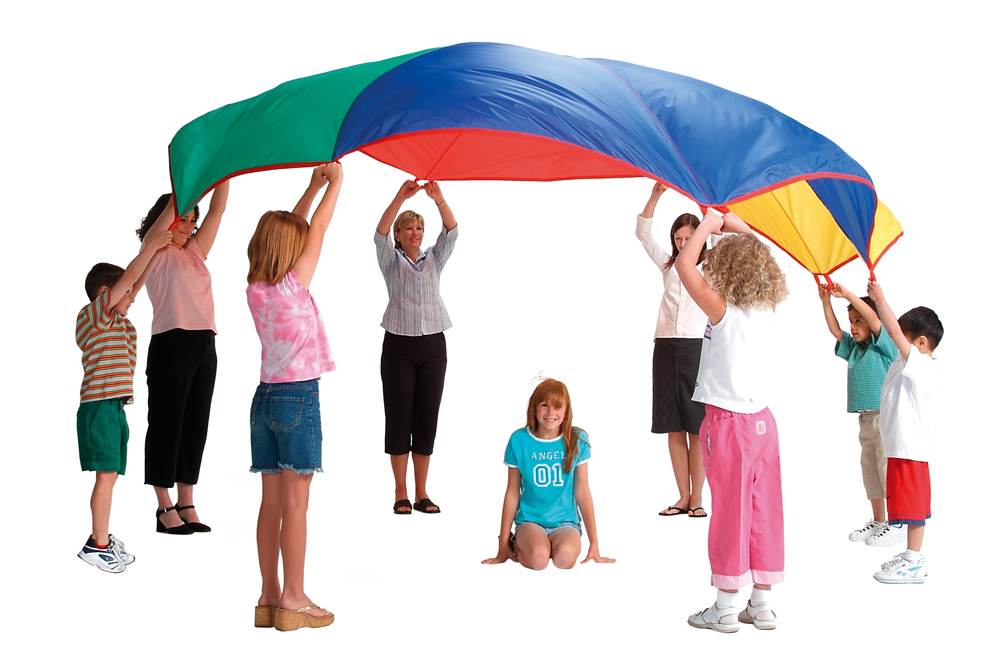
Ah, parachute day. Whether you were a budding star elementary athlete or one of the designated indoor kids, the parachute was a universally appealing gym class apparatus. Something about those glorious primary colors had the power to put children under some sort of enchanted parachute spell, mesmerizing them with its rhythmic movement and waves of red, blue, and yellow. Throw in the fact that we each had our very own handle and this was a participatory physical education dream. The responsibility was great, sure, but the excitement of playing a role in the billowing of the giant parachute was infinitely greater.
It just goes to show that it doesn’t take flashy or expensive equipment to delight a child and pique his curiosity. These parachutes were extremely simple in design and use, yet they rarely failed to entertain us during a vigorous physical education hour. Perhaps it’s a bit of a stretch to label it as actual exercise, but maybe all that arm flapping gave us some sort of low-level workout. As long as it tired us out enough for naptime, our caregivers were more than satisfied.
Just in case you haven’t brushed up on your gym class parachute activities in a few years, here is a handy guide to some of the many magical games offered by this overhyped nylon bedsheet with handles.
Making Waves
Even the youngest Gymboreers can take part in this one, assuming they have the ability to grasp the handle and wave their arms maniacally. To create waves, all the children in class simply have to pick up a handle and shake vigorously. The parachute billows back and forth, the kids ooh and aah in amazement, and the teacher sneaks out back for a smoke.
Mushroom/Jellyfish
I actually believe we may have called this maneuver “Mushroom Cloud,” but that’s probably just a tad too morbid to fathom for five-year old children. “Hey kids! Isn’t this just like an atomic explosion?”
In this exercise, all children have to obediently pull their handle up and over themselves to retain a bubble of air in the center. It’s like a little fort, only much more colorful and slightly awesomer. Plus all your friends are there. I kind of want to stage a Jellyfish right now, it sounds 100% preferable to a day at the office.
Variation: Washing Machine
Make a Jellyfish/Mushroom configuration, but allow the kids to shake crazily while inside. If it’s not realistic enough, feel free to put them in an actual washing machine.
Popcorn
Insert sports ball in center of parachute. Grab handles, shake like maniacs. Commence in delight at rubber balls popping in air. Repeat ad nauseum. Seriously, children never tire of this. You could do it forever.
Shark Attack
The details on this one varied from school to school, but the game universally included screams of bloodcurdling terror. Two children are selected as sharks, the equivalent of “It” in a game of tag. All the other children place their legs under the parachute as the sharks attempt to pull them under in Jaws-like attack mode. Good news is, once you were eaten, you magically became a shark who got to eat swimmers, too. You know, just like in real life.
Merry Go Round
This activity leads me to believe our teachers were fairly sadistic and all had a good laugh in the breakroom at making us dance like obedient trained monkeys. Everyone grabs the handles and the teacher calls out a movement, like “Skip!” or “Run!” The kids run wildly in a circle until they collapse in a pile of heavy-breathing exhaustion.
All Change/All Switch
Here’s a good way to check if your students know their birthdays or which letter of the alphabet begins their name. Make them all hold the chute tightly above them, then call out a command like “Everyone with June birthdays, switch!” The idea was to allow everyone to switch before the parachute fell, but there was always some kid without a June birthday who’d tackle the parachute to the ground before they had a chance to try. Jerk.
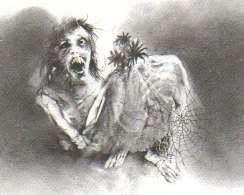
If you ever want to truly terrify your child and ensure they lose at least a week or two of sleep, I advise buying them a copy of Alvin Schwartz’s Scary Stories to Tell in the Dark. Don’t let the name fool you, either--you could tell these in the light and still be scared to the point of mild hysteria. Oh, and if the written word alone isn’t enough to get you, don’t worry; Schwartz has conveniently packed these books with the one-two punch of horrifying tales and gruesome, grisly illustrations. Well played, Schwartz. Our parents may not have been able to convince us to use a nightlight, but you ensured we wouldn’t fall asleep until we’d switched on every bulb in the house. Truly, well done.
Schwartz’s Scary Stories titles included Scary Stories to Tell in the Dark, More Scary Stories to Tell in the Dark, and Scary Stories III: More Tales to Chill Your Bones. Released between 1981 and 1991, these books scared a generation’s worth of children with their fast-paced story telling and spooky unresolved mysteries. Schwartz derived most of his stories from urban-legend type folktales, taking decades-old stories and weaving them into bone-chilling narratives punctuated with eerie sketches by Stephen Gammell.
To this day, I find I can hardly endure a basic Google Image search of Scary Stories to Tell in The Dark--the pictures are just that memorable and that creepy. If you think it’s gross to read about a man whose face is slowly dripping off, imagine having to endure image after image illustrating his unfortunate and gruesome fate. Yech.
It’s unsurprising that Schwartz’s Scary Stories titles are among the most frequently banned of children’s books. After all, Harry Potter contains enough sorcery and magic to get parental watchdog groups in a tizzy, so just imagine the ante upped by adding all manners of severed limbs and hatchet-wielding headless ghosts. These anti-Scary Stories groups allege that the books’ content and imagery is too mature for its intended audience of mid-to-upper elementary students. Other common reasons for the ban are its preoccupation with the occult and the commonplace use of bloody violence. The same adults crying out over R.L. Stine’s tongue-in-cheek Goosebumps series were up in arms over Schwartz’s collections; according to the supporters of the ban, these books were just too scary for children.
Of course, the more something is shunned by adults, the more instantly attractive it becomes to children. Though the original book is nearly 30 years old, it still shows up frequently in current-day top ten banned children’s books lists. Despite its critics’ best attempt to have the book removed from libraries and bookstores, the Scary Stories series maintain an enduring popularity with children itching to test their scare limits.
Schwartz’s simple storytelling and skill for building suspense made these books a thrilling read, encouraging children who may not otherwise show interest in reading to pick one up for the sheer fear factor. Many of the stories even come with handy guides for scaring your friends around the campfire while bottom-lighting your chin with the eerie glow of a flashlight. What could be better than a book that tells you when to raise your voice or to pounce on your friends? I don’t know about you, but I prefer a book with some dramatic stage directions.
While the stories may not be in the realm of adult-geared horror novels, they do have a certain creepiness that resonates with readers even past the intended 7-12 year old audience. The content alone isn’t always particularly terrifying when held against the test of time, but anyone who read these as a child is sure to remember the way that they felt when they heard it initially.
Monsters under the bed or zombies in the closet once seemed not like a fanciful story but as a viable option for children with overactive imaginations. For those with regularly active imagination, there were always illustrations to push you over the edge. I’ve tried to include some of the less grisly ones in this post, but conduct a Google Image search at your own risk. I’m warning you, though, they will lodge themselves somewhere in the innermost depths of your cerebral cortex and haunt your dreams. Just as a caveat, I’m not to be held accountable for your ultimate stomach-heaving reaction to the guts and gore. That one’s all on you.
When you’re one of the big names in kid and infant toys, it’s pretty much up to you to make whatever products you please. A parking garage? A hospital? Sure! Why not? Kids will love it. What kind of kid didn’t grow up wanting to be a parking attendant or graveyard shift night nurse? It’s up to you as the idea people to make these dreams a playtime reality.
Fisher Price is the name behind countless well-known products such as Power Wheels and ViewMaster, but perhaps none as generically memorable as their innumerable well-populated toy sets. Whether through simulating annual medical checkups or churning out make-believe grocery store transactions on our semi-functional cash registers, Fisher Price made the mundane possible. While before we’d have to make do pretending our dollhouses were full service airports, with the endless options from Fisher Price we had the power to make that dream a highly detailed reality.
The company offered endless variations of playsets; to create a comprehensive list of 80s and 90s kits would take pages and pages. To spare you the computer screen eye strain, I’ve narrowed it down to a few of my personal favorites. If you don’t see your favorites, the comment section is yours for the reminiscing. Go nuts.
Little People
You’d think the real little people of the world would band together and protest this sad, round mockery of their existence, but apparently the comparison must not bother them much. Little People were introduced in the 30s in wood form and gradually adapted into the obese little roly polys we know today. They may not be the best healthy body type role models for children, but they’re certainly fun to race-roll down a hill.
Hospital
When I think of settings that would make attractive children’s playsets, hospitals tend not to rank especially high on the list. Stretchers and wheelchairs are fun, sure, but it’s not always the most uplifting play environment. Some versions of the set even came with a dentist chair. Really, what kind of kid doesn’t love the dentist? It’s a failsafe feature.
Cash Register
Ah, provdingapplicable career skills. It’s always good to have a toy that doubles as on-the-job training for a low-paying career path. We may not have all aspired to be doctors and lawyers as children, but darn it, we could make accurate change.
Parking Garage
This is truly one of the most puzzling. What was the Fisher Price corporate creative room meeting like for this one? I’d like to imagine their staff was just driving around, writing down everything they passed, and turning them into mass-produced toys. “Parking meter! City park! Fire station! Cash store! The possibilities are endless!”
School Desk
Why should you have all of your fun at school when you can continue sitting quietly at your simulated school desk at home? Really, the excitement never ends. Whether it’s writing with chalk or arranging word builders, Fisher Price really knew how to strike a budding nerd’s fancy.
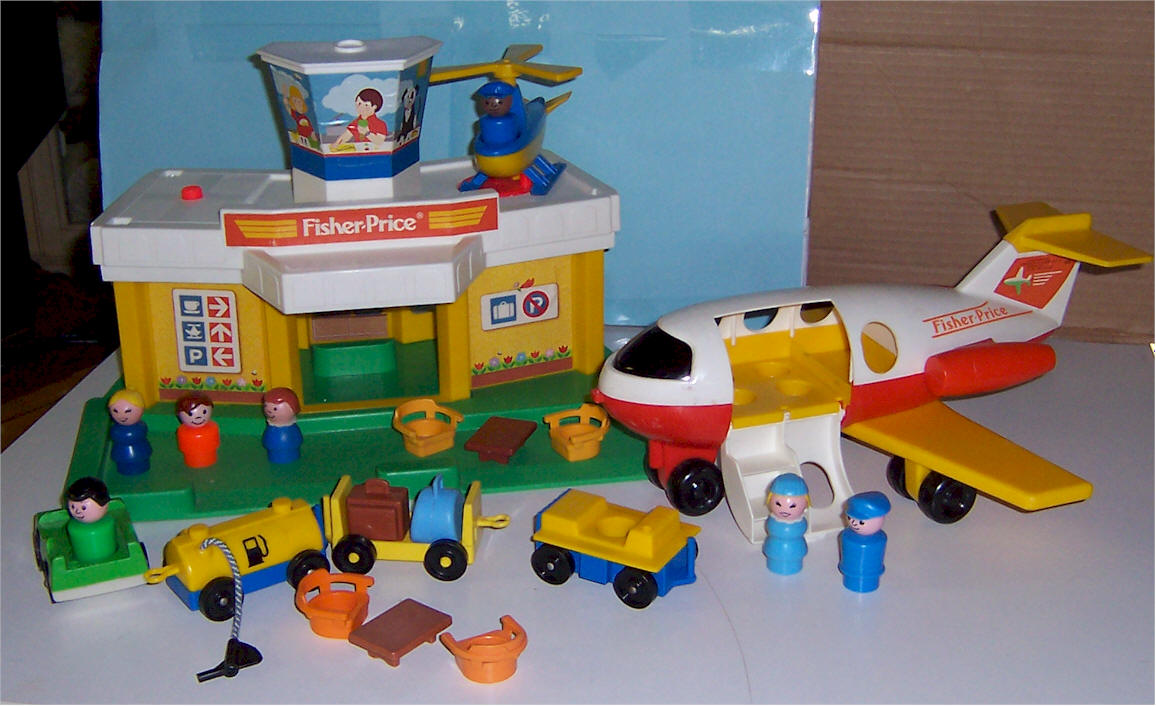
Airport
We all know how children love to direct air traffic and send the bomb sniffing dogs on suspicious flyers. With the Fisher Price airport, we as kids had our very own opportunity to simulate the tedious day-to-day action of air travel. The taking off and landing part could certainly be exciting, but all of that paging people with red courtesy phones could get a bit boring.
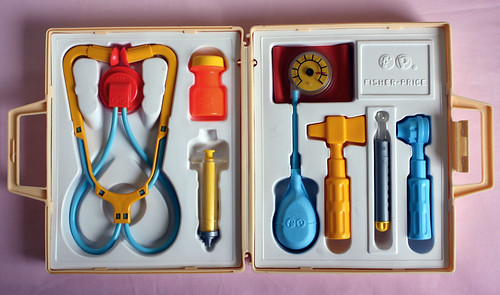
Medical Kit
Finally, the Fisher Price toy set for the ambitious child. From the stethoscope to the fake shot injector, the FP Medical Kit captured all of the things we as children hated about the doctor’s office and allowed us to impose these experiences on our unsuspecting friends. Most of them got the picture after the fortieth knee-jerk reflex test with that little plastic gavel, but it didn’t diminish our sense of fun at forcing them to sit still and wait patiently for their blood pressure reading.
Welcome to the final installment of 80s and 90s Kids’ Arts and Crafts. For parts I and II, check here and here. Thanks again to everyone for your understanding on the intermittent posting over the next few weeks or so during my much-dreaded moving time. A psychology class once taught me that intermittent reinforcement is the most effective variety, so maybe my readership will consequently explode. All this time, I’ve been ringing my little Pavlovian nostalgia bell and bringing you to salivate for post reinforcement daily, when apparently you could have been twice as drooly had I only fed you memories a few times a week. Who knew?
This batch of crafts was especially contingent on reader suggestions, so thank you to everyone who contributed their misty water-and/or-crayon-colored memories of complicated kits and toys our parents used to shut us up for an hour or two. We may not have been creating great masterpieces, but they were at least enough to inspire temporary pride for minimal effort--the preferred combination for children with creative energy but little hopes of a professional future in the fine arts.
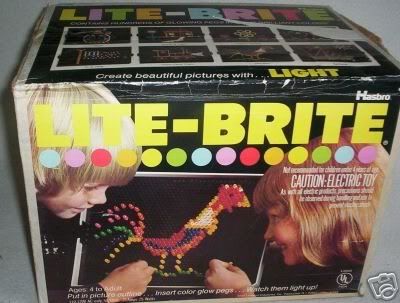
Lite Brite
I hadn’t previously considered this to be much of a craft, but after so many write-ins, it was clear it fits the bill. After all, if Magnadoodle and Etch-a-Sketch made the cut, there’s no reason to exclude the Lite-Brite on account of its transient nature. They weren’t lasting works of art, but they were sparkly ones.
The television commercials always showed children just like us creating elaborate patterns with the tiny bulbs, leading us to believe they held great artistic potential. When we got our very own Lite-Brite, however, it became clear most of them were working from the pre-made pattern punch-out sheets.
In case you haven’t yet gotten over the thrill of tediously placing tiny bulbs in pre-cut sockets, Hasbro online has aLite Brite Simulator. Amazing, right? It’s just as painstakingly laborious as I remember, only in this version you have the option to print your works of virtual art. If you’ll please excuse me, I’m off to spend three hours clicking faux-lit dots into simulated slots.
Fantastic Flowers
As someone who owned this toy, allow me to attest to the fact it was exactly as fun as the commercial suggests. Using little-to-no artistic effort, you could punch out perfectly formed flowers, affix them to premade stems, and voila! Art. The paper it came with was scented, so your result were flowers that smelled like, well, scented paper. Pretty impressive nonetheless.
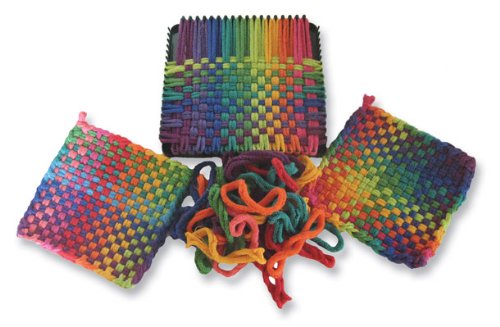
Craft Loops
In retrospect, these seem like a suspiciously-motivated ploy by parents to set up little potholder sweatshop operations in their very own homes. “Oh, here you go, Susie. Just take these loops and this little loom and weave Mommy some pot-holders. Unless you want to burn your fragile little hands on the tuna casserole dish next time. I know how you hated the blistering. So, you know, it’s pretty important you craft an 8 by 10 square from these little circles."
Bedazzlers
If this was still available through a simple TV offer in three easy payments of $9.99, you can bet I’d be dialing that 800-number and reciting my check or money order information. That commercial is incredibly convincing. Blouses! Belts! Boots! Denim jackets! If only I could find that denim baseball cap I bedazzled in my youth, my life could be complete. And sparkly!
This device was relatively simple to use, meaning that in the hands of the wrong person it could lead to some very dangerous non-industry regulated rhinestoning. While a mass-producing manufacturer of clothing realizes that 200 rhinestones on a single collar is a bit much, a bedazzler-crazed regular Josephina may think it’s a grand idea. Heavy, but grand. And, you know. Sparkly.
Shrinky Dinks
You cut ‘em, you bake ‘em, they shrink. Exciting, no?
Lanyards
Any of us who ever went to summer camp are more than familiar with lanyard craftsmanship. Literally the poor man’s friendship bracelet, these useless neon-colored heaps of flexible plastic served as keychains and nametag necklace holders.
We would take great pride in crafting a lanyard for a family member and then wonder why their grateful reaction seemed so strained. As adults, it’s clear to us now that it was because they knew that had to wear around this ugly piece of junk for at least a few weeks until we forgot we’d woven the eyesore.
Stained Glass/Suncatcher Kits
These things always seemed much cooler while still in their original packaging. The sample shown on the package was impeccable: a beautiful, uniformly sun-catching colored glass with excellent use of color. Our own work, however, was usually not quite so dazzling. It may have caught the sun, sure, but it blinded us with streaky, watered-down colored patches overflowing and bleeding into other areas on the suncatcher.
Welcome back to another edition of 80s and 90s’ kids’ arts and crafts. For those of you in the States, I hope you had a nice long holiday weekend. To my international readers, I’m sorry you have to continually endure the assumptions that you care about the United States’ independence. My condolences.
Before we get to the good stuff, a quick note: You may notice the posts here at Children of the 90s becoming a bit more intermittent over the next couple of weeks. Don’t worry, I’m not going anywhere. Well, actually the previous statement is completely false: I am going somewhere, though the move will take place in the real physical world instead of the virtual one. I’m in the midst of a housing to move to parts as of yet unknown and am thus fully consumed by the arduous task of hauling furniture and packing up boxes.
I’ve never been much for manual labor, so the inevitable strain on my delicate self is taking up valuable blogging time. For the next few weeks, I appreciate your understanding of our temporary on-again, off-again relationship. Believe you, it’s not you, it’s me. And my incredibly overstuffed apartment.
For now, though, let’s resume our stroll down memory lane into the world of 80s and 90s arts and crafts. Believe me, I would rather be doing any of these things--no matter how ultimately tedious--than packing up a few years worth of accumulated stuff. If I had a velvet poster to color in or a spin-art wheel to operate, you’d bet my progress would be slowed significantly. Not to mention my belongings would be far more paint-splattered, though be fair it would be in an artfully random pattern.
Based on your much-appreciated write-in suggestions, here are a few more of the vaguely arts and crafts-related activities that held our attention as children. There’s still a part 3 likely coming your way, so feel free to add additional suggestions to the comments section or by email at childrenofthe90s@gmail.com.
Scratch Art
For those of us lucky enough to have parents willing to spring $4.99 or so for a packet of pre-made scratch sheets, we enjoyed the hassle free scraping of surprisingly colorful designs from a black background. Others among us didn’t fare quite as well, opting to create our own scratch boards from, well, scratch.
Doing so involved the arduous task of filling a full page with random colored patches and using an entire black Crayola crayon to do you color-cover bidding. Your hand and arm would be incredibly exhausted from the whole ordeal, but at least you were able to reap the reward of some sweet vibrant etching.
Velvet Coloring Posters
I passed one of these at CVS the other day and found myself fighting the urge to purchase it and customize my very own velvet portrait of a unicorn galloping whimsically across a full arch rainbow. Despite my knowledge as a grownup that these posters are extremely tacky, there’s something so tempting about embarking on an endless and time-consuming velvet poster coloring project. Plus they’re velvet. Velvet! That stuff comes across as pretty classy to a seven-year old.
Ironable Perler Beads
We spent many, many hours in my house tediously placing plastic beads a millimeter in diameter each onto flat bumpy molds. Whoever thought these up was either a genius or incredibly sadistic, depending on your views on occupying a child with a mindless task for multiple hours at a time.
The molds came in different shapes and could produce different designs using the multicolored beads. Simply cover, iron, and ta-da! A piece of useless junk. But hey, it was your piece of useless junk. There’s a difference.
Spin Art
Just in case you were looking for a way to make painting messier and more airborne, you’re in luck: someone else has already come up with it and mass-marketed it. There actually used to be a professional Spin-Art center at our local mall, but I’m guessing the availability of allegedly easy-to-use at-home kits put them out of business.
The process was simple but undeniably attractive to mess-hungry children. You put a piece of paper on the spinner, activated the motion, and squirted various paint colors in its general vicinity as it spun. It was like a maxed-out version of the Spirograph: no skill required, guaranteed to create interesting artful symmetry.
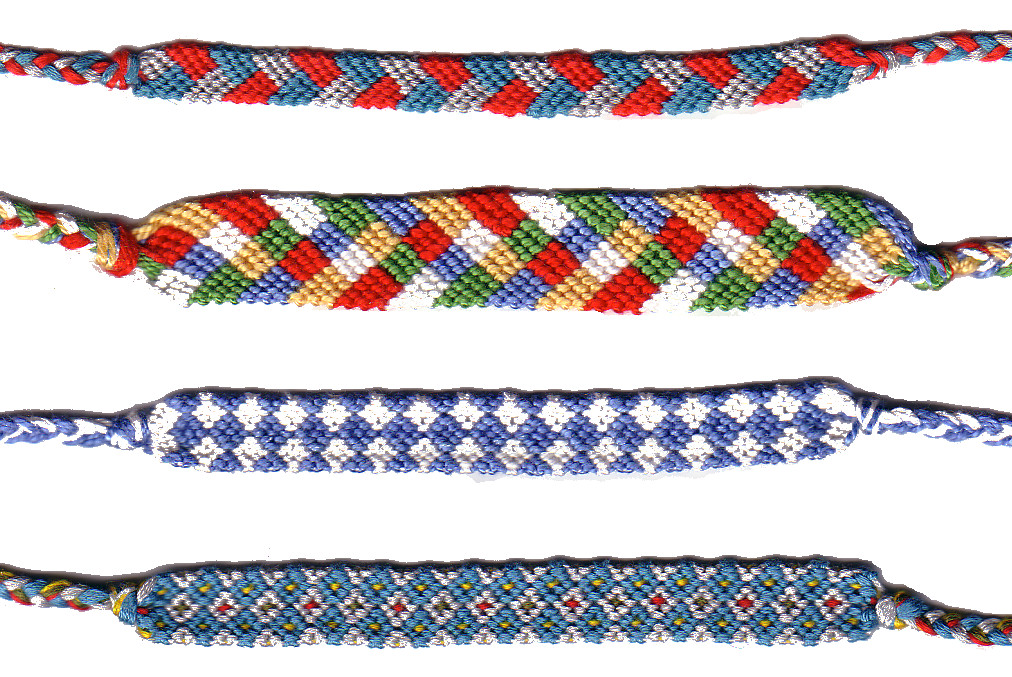
Friendship Bracelets I recently caught an episode of How It’s Made featuring the hammock-making process that led me to believe I could someday take on a lucrative career as a hammock craftswoman. The reason? The countless hours I spent weaving embroidery floss into masterfully crafted bracelets and anklets. How else can we children of the 90s put to use our skill at creating patterns like tornado, chevron, and candy stripe?
If you have a solution, feel free to let me know--I’m actually in the market for a new career. I don’t have Friendship Bracelet Making as its own category on my resume, but I’m willing to work it in for the right professional macrame post. Really, let me know.
Upon further examination, it seems like I should have titled this feature “Craft Aids for the Talent-Impaired Child Artist.” Parents of young children in the 80s and 90s were coming around to the self-esteem movement--meaning they had to pretend everything we did was pure gold in in an effort to not damage our allegedly fragile child egos. It’s the reason we all think we’re so good at everything. Gen Xers may have been better off with their cynicism--by the time Gen Y rolled around, our every breath was an action worthy of praise.
Whatever the reason, an overwhelming number of art-themed items from our 80s and 90s childhoods required relatively little skill or talent of any kind. Whether through creativity-eliminating drawing guides or mistake-erasable drawing tablets, these crafts held very low expectations for our artistic ability. That’s either very kind or very depressing, depending on how you look at it.
There’s no chance I could sum up all of the nostalgic arts and crafts items I’ve come up with--I just spent about forty minutes oohing and aahing over memory-jogging Google images. This is destined to be a multi-part series, so feel free to reminisce about your own favorites in the comments section. If your memories are convincing enough, who knows? They might just end up in Part II. You can only hope.
Fashion Plates/Light-Up Tracing Desk
Here is the ultimate in talent-free artistic expression: simply rub over or, as technology improves, trace some mix-and-match designs onto your very own piece of paper. You could switch out the different plates to change outfits, faces, and shoes. Inspired by the plates used by actual fashion designers, these more primitive versions were marketed to children. I had the later update light-up desk, which yielded a similar result with the added bonus of some technology: a little lightbulb.
Spirograph Introduced in the mid-60s, the Spirograph has long been a favorite of geometrically-minded children. Using some mysterious principle described by lengthy equations and assorted Greek letters in the Spirograph Wikipedia entry, the circular gears produce various patterns and symmetrical shapes when poked with a pen or pencil. Growing up, our local science museum had a giant Spirograph that held some half-hearted intention to teach us some math, but unsurprisingly most child patrons were only interested in taking home their personal tear-sheet drawing.
Etch-a-Sketch/Magnadoodle/Magic Memo Pad
These devices seem lumpable into a single category on the basis of their underlying theme of immediately disposable, mess-free art. It’s clear why these toys appealed to our parents--no muss, no fuss, no ugly pictures they felt obligated to display on the fridge with forced pride. Simply swipe, shake, or peel, and start again--endless renewable art fun.
Kid Pix
For the tech-savvy among us, the computer became a veritable playground of virtual painting. I was not actually lucky enough to own Kid Pix, but I did occasionally have the chance to observe its awesomeness with its stamping and sound effects at a friend’s house. On my own, I was relegated to playing with the gradient function on our ClarisWorks, but I spent most of my allotted computer time fuming about my lack of Kid Pix.
Paint by Numbers/Paint With Water
Paint-by-number sets were a popular and highly tedious exercise in futility. It took great resolve and concentration--attributes children do not generally possess--to get through one of these pictures. Once you get all the way up to matching all of the tiny little 14 spots to the number 14 color, several hours have elapsed. Bummer.
The Paint With Water Sets were far simpler, though they held a much greater novelty factor. Simply wet the colored part of the paper and it becomes drippy and messy and allegedly paintable. I actually had a several minutes-long discussion with my boyfriend regarding whether these mysterious sets actually existed or if I pulled the notion from the far expanses of my overactive imagination. Grueling Google searches conclude that they do in fact exist and thus I did not dream up a Muppet Babies-themed wonder featuring built in paper paint. Score one, me.
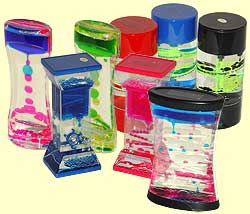
If there was ever a piece of compelling evidence that children are incredibly easily amused by visual stimuli, liquid timers would be it. All it takes it some oily liquid and few drops of fluorescent food coloring and we as kids were rapt with attention for hours. A paperweight with limited functionality may not seem like an attractive toy for a child, but any parent who ever brought a kid into a science museum gift shop or Discovery Channel mall store realized liquid timers held a mesmerizing appeal. Standard kitchen egg timers may not have given us palpitations, but place a colorful liquid timer in front of us and we were set to stare for a solid 20 minutes.
Liquid timers came in a wide variety of shapes, sizes, and permutations, providing children with a vast spectrum of semi-scientific objects by which to be captivated. While other toys relied on highly interactive features and endless manipulable amusements, the various producers of liquid timers knew parents were far more interested in a toy that made their child sit quiet and still than one that allowed them frantic movement.
I’m not a parent, but if I had the choice of something like a pogo ball or a liquid timer, you can bet I would go for the colorful dripping paperweight. Not only is the chance of skinned knees far less likely, but your child will likely be so entranced by the dripping timer that they may unknowingly commit to vacuuming or doing the dishes.
The fact that these desktop toys were sold primarily in science-themed stores is fairly laughable; sure, there’s some science behind the dripping mechanism, but it’s unlikely a child ever actually learned anything from one of these timers. They rarely came with a detailed “How It’s Made!” guide, leaving kids to speculate on the vaguely scientific and educational nature of the equivalent of a colorful leaky faucet. It may have been on the shelf at the Discovery Channel store, but there was relatively few discoveries to be made. You turned it, it dripped, the end.
The fancier models may have incorporated some mysterious chamber changing and reverse direction technology, but it never made any effort to educate us on why or how. Granted, liquid timers were marginally more educational than the usual crap that occupied our playtime, a fact that was probably more than enough to appease the parents shelling out for these useless space occupiers.
A brief research investigation (read: Google search) of liquid timers was by far the most educational interaction I’ve had with them so far. A potentially credible site taught me that the timers are filled with liquids of varying densities that have an oil-and-water type relationship: one liquid passes through the other by means of chemically variant and non-combinable properties. That sounds accurate, right? I tried to science it up a bit with my limited relevant vocabulary, but the basic principle seems like a valid explanation. Thanks, Google.
That same Google search, however, yielded another interesting tidbit of information: manufacturers of liquid timers do NOT (capitalized, underlined, bolded, and italicized: these sites mean business) recommend these items for children. Apparently some curious children saw fit to try to break open their hypnotically soothing toys for a taste of the undoubtedly delicious colored liquid inside. Kid deductive reasoning concludes that if it looks like grape juice and drips like grape juice, it’s probably grape juice--a foolproof formula.
Despite its potential toxicity, it’s obvious why our parents gave into our demands for liquid timer ownership: these overpriced paperweights were a much-welcome distraction. Admittedly they didn’t do anything, but in an age before kids were incessantly preoccupied with technology that wasn’t necessarily such a bad thing. We could only hope to recapture the whimsy and effortless amusement of our younger years. While now it takes at least four forms of technological entertainment to hold our attention for any period of time, it could do us all some good to spend some time gazing aimlessly into the liquid timer-filled abyss. If you don’t have an abyss on hand, your desk is probably also a suitable alternative--just make sure you’re gazing aimlessly for the full liquid timer effect.
Current celebrity critics may be up in arms over the racy and overnight de-Disnified Miley Cyrus, but her path as a child-to-rebellious-teen pop star is pretty well-worn territory. Child stars have been reinventing themselves as alleged adults for years. In the 1990s, a wave of self-proclaimed virginal and innocent adolescent teenage pop stars paved the way for the downslide into inevitable controversy. These girls proved there’s only so long managers and publicists can capitalize on and profit from your jailbait allure--at some point, their public personas needed to grow up.
As some of these starlets have shown, the transition from bubbly teen to legitimate grown-up artist is not an easy one. While some may manage to endure the change relatively unscathed, most lose some marketability with each passing year and are forced to continually reinvent themselves. So next time you hear Miley tell you she can’t be tamed, you should probably just take her word for it. Looking at her predecessors, it seems like a likely outcome.
Britney Spears
We First Knew Her as: Mickey Mouse Club Member on the 90s revival of the children’s variety show, child contestant on Star Search, very brief stint as member of girl group Innosense Achieved Major Stardom as: Vaguely inappropriate but supposedly innocent school girl uniform-clad singer of “Hit Me Baby One More Time” Foray into Film: Starred in box office bomb and general cheeseball embarrassment Crossroadss And Then: Reinvented self as newly edgy Slave 4 us; dances with python And Then: Marries perpetually wifebeater-clad backup dancer Kevin Federline, procreates; divorces The Downslide: Endured a slew of personal struggles, shaved head, stint in rehab, embarrassing VMA performance in spangly bra--still managed to release popular CD Number of Fragrances Released in the Meantime: Seven, including one subtly called “In Control” Now: Under tight conservatorship by her father, released MTV documentary re:sanity and embarked on high-grossing Circus world tour
Christina Aguilera We first Knew Her as: Spears’ fellow Mouseketeer on “The Mickey Mouse Club,” Star Search contestant, singer of “Reflection” fromDisney's Mulan
Achieved Major Stardom as: A Genie In a Bottle, baby
And Then: Released a Spanish-language album. You know, because her dad is from Ecuador. Strangely did not release Irish music CD to celebrate mother’s heritage.
And Then: Got “Dirrrty” and “Stripped,” dyed hair black, wore questionably revealing outfits, shed teen bubble gum pop image
Followed by: Vaguely Marilyn Monroe-esque re-reinvention, more mature musical style, fewer morally reprehensible music videos
Now: Canceled pending 2010 tour in midst of underwhelming ticket sales
Jessica Simpson
We first knew her as: Small-town Texan Christian singer with unreleased album (her minor Gospel label went under)
Achieved Major Stardom:Sweet Kisses album with top-charting singles “I Want to Love You Forever” and “I Think I’m In Love With You”
Plus: Dated second-tier Boy Band 98 Degrees front man Nick Lachey
And Then: Married Lachey; the two costarred as newlyweds in the cleverly named reality series Newlyweds. Gained reputation as dumb blonde for inability to distinguish between chicken and tuna
Maintained Fame With: Much-publicized and scantily-clad role in the film adaptation of The Dukes of Hazzard
Downslide: Divorce, dwindling record sales, straight-to-DVD movie roles, rocky romances with John Mayer and Tony Romo. Overly publicized weight gain exacerbated by sadistic stylist with an inexplicable penchant for skintight Daisy Dukes
Now: Return to reality TV with VH1’s The Price of Beauty, serves as general muse for hairstylist Ken Paves
Mandy Moore
Achieved Major Stardom as: Opening act for boy band Backstreet Boys; released top single “Candy” featuring a music video in which the then-15 year old Moore drives a green Volkswagon Beetle
And Then: Released lightweight album I Wanna Be With You; title single featured in teen ballet movie Center Stage
And Then: Appeared in numerous films including The Princess Diaries, A Walk to Remember, Chasing Liberty, and Saved; far exceeded cinematic success of teen pop princess peers
Also: Dated Wilmer Valderamma, Andy Roddick, Zack Braff, DJ AM; settled down and married singer Ryan Adams in 2009
Should be Noted: Moore deserves some form of 90s Pop Princess prize for maintaining her down-to-earth reputation through her journey from teen star to adult celebrity, though I call for a slight point deduction for her preoccupation with and persistent attendance at Ultimate Fighting Championship events



 Insert sports ball in center of parachute. Grab handles, shake like maniacs. Commence in delight at rubber balls popping in air. Repeat ad nauseum. Seriously, children never tire of this. You could do it forever.
 Here’s a good way to check if your students know their birthdays or which letter of the alphabet begins their name. Make them all hold the chute tightly above them, then call out a command like “Everyone with June birthdays, switch!” The idea was to allow everyone to switch before the parachute fell, but there was always some kid without a June birthday who’d tackle the parachute to the ground before they had a chance to try. Jerk.