Tuesday, March 30, 2010

American Girl


I'm still moderately crushed that they didn't unleash the glory of the respective downtown-based American Girl Places until I was far past the acceptable American Girl consuming age. I would have been all over that. I mean, tea parties? With your doll? Is there some sort of a sign up list somewhere? Because I would like to enlist myself immediately.

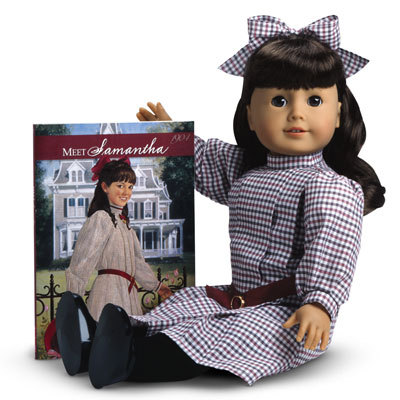
Just the other day, I was at the home of a family with young girls and found each one proudly toting a bona-fide American Girl doll. The jealousy reflex in me sprang forth, strong as ever. As much as I begged, my parents would never cave and purchase me a wildly expensive Samantha doll per my requests...er, demands. My friend had one complete with it's own turn-of-the-century style miniature version of the rich person wire bed on which she slept. Granted, these young girls I encountered this week had the far inferior "Just Like Me" My Twinn-knockoff dolls complete with eerily identical features and customizations, but the jealousy reflex enacted nonetheless.

While American Girl may have started with the noblest of literacy and girl pride-minded intentions, the brand morphed into a major franchise of merchandise and self-proclaimed collectibles. I was an avid reader of the books, so imagine my delight as a child when the mailman saw fit to bring me my very own American Girl merchan dise catalog. If I had known what crack was at the time, this catalog would have become its mildly less addictive equivalent for my 10-year old self. I spent hours meticulously marking pages, indicating not only which dolls and accessories I preferred but also which me-sized American Girl-style clothing options I would hopefully someday wear with false-modest pride. Who doesn't want colonial frock or a shirt whose collar suffocates me with its early 1900s high buttonedness? These things are relatively irresistible. Well, to girls in the target 8-12 demographic, that is.


This effort-laden catalog scouring turned out to be for naught, but it did teach me a valuable lesson about coveting and consumerism. That is, that I really, really like it. Thank you, American Girl. You've served me well in my path to shopping addiction.

The spark of the American Girl concept was born in the mid-80s when creator Pleasant Rowland visited colonial Williamsburg, enjoying the impact of the fully immersive experience. Later, when shopping for gifts for her tween-aged nieces, Rowland realized that the range of dolls available to preteens was highly limited. The focus of these dolls, she observed, seemed to be on either mothering (baby dolls) or aspiring to teenagehood (Barbie-type fashion dolls). No dolls were specifically geared toward the interests of then generally underserved preteen demographic.

Initially launching the line as a mail-order enterprise, Rowland created the fledgling American Girl franchise in 1986. American Girl originally featured three historical girls: Kirsten Larson, Samantha Parkington, and Molly McIntre. Each doll came with three books about her life in her respective historical setting and optional clothing and accessories based on the character. American Girl was born.

American Girl quickly grew into a veritable operation, releasing birthday books, seasonal books, and my personal favorite in 1988: life-size matching clothing for the doll owner. The line veered into some alternate territories, but for the most part its focus was on the historically relevant doll line with its corresponding books. The original characters released in 1986 were:

Kirsten Larson (1850s)Kirsten is a Swedish American living in Minnesota in the mid 19th-century. Kirsten is a kind, sensitive girl open to new experiences in her new country. She was an avid sewer and had an adventurous spirit. Plus, she wore her hair in an awesome braid/Princess Leia Cinna-bun hybrid. I liked the idea that she was Minnesotan like me, but I could never seem to get my hair to stay in those braid loops like hers.


Samantha Parkington (1900s)

Samantha Parkington is a turn-of-the-century orphan living with her rich Grandmary. Yep, Grandymary. I guess that's Edwardian rich-speak for Grandmother. Samantha is curious and progressive, excited in new prospects and ideas. She taught me that you can be both rich and kind. Plus that it's totally awesome to have a slew of servants at your disposal. I don't think that was the point, of course, but I definitely picked up on it.

Molly McIntire (1940s)
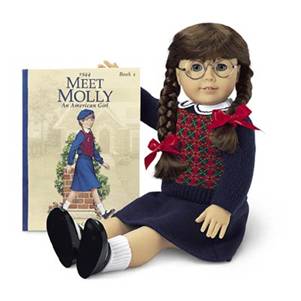
Until the line expanded into more ethnically diverse characters, Molly is the original line's token "girl with the glasses." Molly is lively and scheming, with a father abroad fighting in World War II. She has a taste for glamour and excitement and has vivid imagination.

The line quickly expanded to include more characters based in different historical periods. In 1991:

Felicity Merriman (1770s)
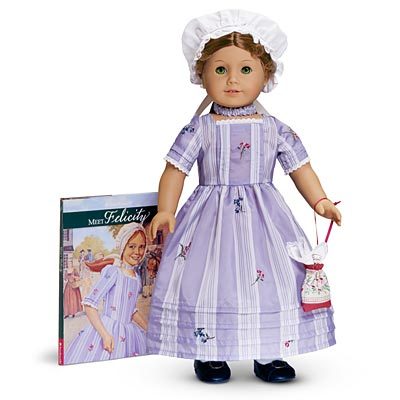
It's surprising Felicity wasn't in the original release group, considering creator Pleasant Rowland's claim that a visit to colonial Williamsburg inspired the series. Felicity is coming of age during the Revolutionary War. She is highly independent and spunky and rejects many of the feminine ideals assigned to her my her time period.

In 1993:
Addy Walker (1860s)
The series' first African American character, Addy's books explore more complex societal issues, depicting her life as an escaped slave. Addy doesn't believe slavery is fair and is a proponent of racial equality, finding the North to be similarly prejudiced to the South from which she escaped.

In 1997:
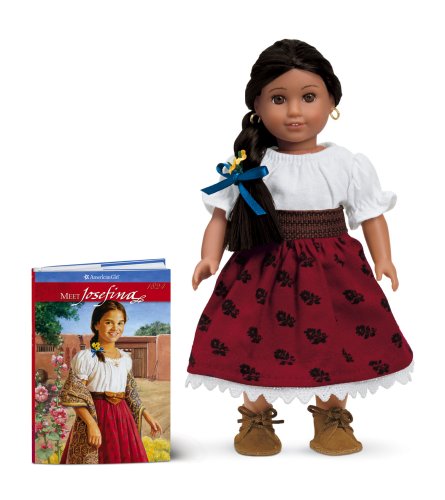
Josefina Montoya (1820s)
Josefina is a girl growing up in New Mexico before the Mexican-American war, when the period was still under Mexican control. Her books integrate some Spanish terms and examine Josefina's life following the death of her mother. She is shy, thoughtful, and caring. Plus, we get to pronounce her name "HO-se-fina", which is totally awesome.

In the 2000s, the company later added post-white settlement Native American Kaya'aton'my,first-generation American Russian Jewish Rebecca Rubin, spunky tomboy Kit Kittredge, and civil-rights minded Julie Albright. The diversity of character and ethnic background grew significantly over the years since the original 1986 release, but the general guiding principles remain the same.

The books had their flaws, but they fulfilled Rowland's original vision of interesting young girls in history and lives unlike their own. Rowland introduced girls to disparate historical periods through the lens of girls who were their own age, with similar hopes and ideals. It was an innovative idea, and kids bought into it with great fervency. Bought into it so much, of course, that they begged their parents for books, dolls, magazine subscriptions, costumes, accessories, and everything else that turned this educational premise into a lucrative financial enterprise. It may have worked too well on me; I'm still putting that Samantha doll on my birthday list. It's worth a try. If you're interested in fulfilling my decades-long dream, don't forget to throw in the wire-frame bed too.


Monday, March 29, 2010

Children of the 90s One-Hit Wonder Mash-Up: 1996 Edition

It's about that time again, folks. Time to delve into the magical world of bygone one-time chart topping artists, that is. The one-hit wonder retrospective is always a bit surprising. In some cases, we may have once thought these artists to be poised for greatness and industry longevity, only to have since forgotten about them entirely. Whatever the explanation, these artists hit it big in mainstream markets with an appealing single and failed to deliver on the much-hyped follow-up.

The outlook's not all bad for our one-hit wonder makers, though. If you ever go to the dentist, you're pretty likely to hear their former hit cropping up on the inoffensive LITE FM radio station being piped into your examination room. With enough laughing gas, you can probably even transport yourself right back to where you were when you enjoyed the song the first time around. Really, with enough laughing gas, anything is possible.

Though they may not have stood the public opinion-administered test of sophomore CD success, in 1996 these songs were among the most-played on the airwaves and in Discmans (Discmen?) everywhere. Considering they don't even make Discmans anymore, these songs aren't the only thing that failed to live up to their initial fanfare and promise. Tough break all around.


Peaches (Presidents of the United States of America)


For the record, this is clearly not the video, just the song set to a bunch of peach-related images. It is sort of amusing though, right?

We just can't leave well enough alone in this country, can we? We're so full of repressed latent sexual content that we keep projecting it onto innocent songs. At least that's what PotUSA claim. The song is really just about peaches. Get over it, people. It's offensive music at its best, so please stop trying to assign it some dark deeper meaning.


Counting Blue Cars (Dishwalla)


This is one of those sort of melancholy-tinged songs that can really pull your mood in the general direction of ennui. Most often, this song is referenced for its line, "Tell me all your thoughts on God/'Cause I'd really like to meet her." Yep, her. How out there is Dishwalla? Just imagine what else they could have made quietly gender-bendingly shocking if they'd churned out a few more chart-toppers.


I Love You Always Forever (Donna Lewis)


I distinctly remember listening to an end-of-year 1996 countdown and hearing this song as the year's top chart hit, so imagine my surprise at learning that this is the last well-performing song we saw from Lewis. "I Love You Always Forever" has that light, airy, sticks-in-your-head-for-all-eternity quality to it. It may not be heavy on substance, but the song makes up for it with catchiness. So much catchiness. Be warned before listening: you're going to be singing this one for the rest of the day.


That Thing You Do (The Wonders)


Okay, so this one is sort of cheating. Technically, it's a song from a movie about a band who learns firsthand what it means to be one-hit Wonders (formerly one-hit Oneders-- feel free to mistakenly pronounce it Oh-need-ers. Really, go ahead. I won't tell.) This is a great movie with an undeniably catchy title song, so it's no surprise that the music translated well to the real-life pop charts. Of course, it wasn't quite at the movie's level of Beatlemania-esque hysteria, but it performed pretty well for a song released by a fictional group.


One of Us (Joan Osbourne)


Every once in awhile, the public just yearns for a pop song that dares to ask the tough rhetorical questions. It helps, of course, if the songwriter is articulate enough to include lyrics like, "Yeah, yeah/God is good/yeah, yeah/God is great/yeah yeah yeah yeah yeah." Throw out those old hymnals, people; this girl's a theological poet.


Macarena (Los Del Rio)


I know, I know, how many times can we talk about the Macarena here at Children of the 90s? Apparently the answer is something like bi-weekly, but we'll have to chalk it up to the fact that it was just that infectious. Forget parental warnings: his single needed a CDC warning. After the song enters your ear canal and undergoes a brief incubation period, The Macarena is doomed to be contagious to others for up to a week. We still see flare-ups of spontaneous outbreaks of the dance today. I think you never really get over it; we're all carriers of the dormant Macarena, our bodies poised and waiting for the song to strike so it can break out into well-ordered group line dancing.


Jellyhead (Crush)


Jellyhead is one of those songs that you might still be sort of embarrassed if it came up on your iPod on shuffle in front of other people but that you secretly relish listening to on your own. Its techno-pop dance beat is fun and upbeat, which might sound strange for what is essentially a breakup song. Somehow, though, Crush makes it wok.


Breakfast at At Tiffany's (Deep Blue Something)


It's a sweet song, but the premise is a little thin, don't you think? If you no longer had anything in common with your significant other, would a shared reminiscence about an Audrey Hepburn movie really rekindle your relationship? Especially considering that the band's original idea for the song had featured Hepburn's Roman Holiday instead. I guess, "So I said, what about, Ro-o-man Holiday" just doesn't have the same ring to it.


Everything Falls Apart (Dog's Eye View)


This is another one of those deceptively upbeat songs, though to its credit "Everything Falls Apart" has significantly more depth than say, "Jellyhead." The music video is just so 90s, from the overacting antics of the lead singers with the brief vignette cutaways. That lead singer really rocks that grungy button-down left open over a t-shirt, too.


Closer to Free (The BoDeans)


This song was actually released in 1993, but it didn't get any chart action until 1996. It became the theme song for the TV drama Party of Five, assuring the song's quick ascendancy to popularity. The BoDeans also recorded a lesser-known theme for Jennifer Love-Hewitt's short-lived Party of Five spinoff Time of Your Life. Unfortunately, like the new show, it seemed their mass appeal was all tapped out.


Their time at the top may have been brief, but most these songs are memorable enough to spark a little nostalgia. Just because we don't have daily conversations about the rise and fall of Dog's Eye View and Dishwalla doesn't mean they're completely forgotten. If you hear one of these songs on the radio, it's more than enough to jar you back to 1996. Well, you know. Give or take some flannel and stringy hair.

Friday, March 26, 2010

Shel Silverstein Poetry Books


It takes a special kind of adult to truly get inside a child's head. We so often forget the whimsical, imaginative world of childhood as we're hardened by our collective cynical ascendancy to adulthood. It's rare to find a grown-up who is able not only to get in touch with his inner child, but who is able to bring it to the surface and forge a lucrative career from it. While his friends are off becoming doctors and lawyers, he's got to be content with writing poetry about ponies and dragons. It's a tough job, certainly, but someone's got to do it.

Granted, Shel Silverstein is a special case in children's book authorship; his extensive range of career endeavors would likely make many parent purchasers of A Light in the Attic or Falling Up blush. Silverstein's work spanned drawing cartoons for Playboy magazine to writing STD-laden songs entitled "Don't Give a Dose to the One you Love the Most." And did I mention he wrote Johnny Cash's country music hit "A Boy Named Sue?" Oh, right, and in the late 80s he wrote nine plays for adult audiences. You can't say the man didn't have varied interests; Silverstein squeezed several lifetimes worth of lucrative artistic careers into a mere 67 years. Not too shabby.

To generations of kids in the mid-to-late 20th century, Silverstein provided us with a certain silliness that was simultaneously irreverent and irresistible. Not all parents were crazy about the sometimes inane and often ridiculous content in his poetry, but Silverstein undeniably sparked a love of reading in children. For the most part, adults were just happy to see their kids excited about reading; it may have not have been heavy literature--I don't think a poem entitled "Ickle Me Pickle Me Tickle Me Too" registers in that class--but it was reading nonetheless. It was enough to make even the begrudgingest readers among us pick up a book of our own will and accord. That's pretty strong stuff.


Silverstein's unique sense of word choice and clever use of double meanings paired with cute illustrations provoked delight in young children. Finally, here was something right on pitch with the mysterious inner workings of a child's brain. Based on Silverstein's astronomical success, the recipe for writing a really effective children's poem seems to be as follows: write something kind of crazy. Show it to an adult. If the adult think it's crazy, stop drilling; you've hit children's literary oil. It's a tried and true formula: if adults find something to be crude and distasteful, that's the ultimate litmus test of its potential appeal to children.


Children have a far likelier propensity for possessing a sense of humor than their grown-up counterparts, so this formula was right on target. Silverstein found monumental success with his children's poetry anthologies, outlasting some of the 90s' most persistent blockbuster authors on the New York Times Bestseller list. "A Light in the Attic" spent a remarkable 182 weeks on the list following its 1981 release, proving that books geared toward children can have serious mass market appeal.

There was, admittedly, a certain naughtiness to his children's poetry that made children devour it so gleefully. Many of the poems included PG-rated punchlines or humorously violent turns of events that delighted children with its unexpectedness. For example:


That's funny, right? Come on, you know it's a little bit funny. That illustration is killer. Admittedly, toilet humor was prevalent, but it was used cleverly and quietly, like this:


All in all, fairly innocent stuff. It's not exactly racy content, it's just a joke. You know, those things with the set-ups, the misdirections, and the surprise endings? Kid love 'em.

Unfortunately, not everyone was on board with Silverstein's sense of humor. Wherever you find someone trying to bring something fun and enjoyable to children, you undoubtedly find a group of sour-faced adults hell-bent on killing every last speck of joy and laughter. Naysaying parents argued against a few specific poems, citing their content as being inappropriate for children and encouraging disrespectful and anti-authority behavior.

Some found contention with this poem in particular:


What a group of killjoys, huh? The phrase "lighten up" was coined with this group of ignorant indignants in mind. If your child reads this and immediately proceeds to your kitchen to smash dishes one by one in a subversive manner, then we'll talk. Until that point, we might all want to work on developing at least a mild sense of humor. It might diffuse some of that tension that's sure to arise from the brooding resentment your kids will unleash on you twenty years down the road.

Another poem from A Light in The Attic caught even more flack from sanctimonious parents for its allegedly outraging message. "Little Abigail and the Beautiful Pony" detailed the story of a little girl who begged her parents for a pony, telling them she would die without it. They refused her the pony, as parents are wont to do, and she did indeed die. The poem closes with the line, "This is a good story to read your folks when they won't buy you something you want." Holy banned books, that's funny stuff.

It seems the moral of the story is that it's probably okay to expose kids to humorous material. In fact, I'd even prescribe it for your own children, if you have any. I'm not a doctor, though, so you might want to check with a professional before administering that hilarious treatment. Either way, I'd venture it's a pretty safe bet to say your kids aren't going to develop into antisocial sociopaths for having read a clever poem or two. Just a hunch.

We all read it, and we turned out okay, right? Well, to a point at least. Our snarkiness and self-satisfied sense of irony had to come from somewhere, right? Whatever the potentially damaging impact alleged by parent groups, the positive impact of children enjoying reading outweighs the negative of ending up incredibly uptight, humorless, and unyielding. So, thanks, Shel. We'll see you where the sidewalk ends.

Digg This!