Tuesday, June 15, 2010

Indoor Play Places


For those of us who did not grow up in consistently temperate climates, our parents faced a serious conundrum: how to drain us of our boundless energy when the outdoor playgrounds were buried under six feet of snow or consumed by a mighty hurricane? Without the benefit of outside space with major running-around space capacity, it was difficult to sufficiently tire a kid out in time for naptime. What's an exhausted and weather-beaten parent to do?

Luckily, enterprising child-minded 90s entrepreneurs had the answer: indoor play places. In these colorful, kid-friendly enclosed playgrounds, masses of children had the opportunity to run wild to their hearts' collective content. Parents, by lucky virtue of their inability to fit in those constrictive plastic crawl tubes, were mercilessly spared and allowed to sit back and relax from the observation area. Overall, a win-win situation.

All it took was a quick removal of shoes to be stored in the play place cubbies and we were generally good to go. Crawling spaces, climbing ropes, ball pits, and slides awaited us at every visit, turning these indoor play spaces into popular venues for birthday parties and playdates. While their appeal waned in the late 90s and many chains merged and eventually filed for bankruptcy, I'd like to remember them as they were: chaotic, germ-ridden, and filled with screaming children. At least we have our memories.


Discovery Zone


For a brief period in the early-to-mid 90s, DZ play places were a major force, opening centers in cities across the US. These self-proclaimed "indoor fitness centers" for children boasted an array of climbing, swinging, and sliding apparatuses. Perhaps DZ got a bit greedy, as their haste in opening venue after venue left them in a relatively dire financial situation. In 1996, the company filed for bankruptcy, inspiring the more dominant Chuck E. Cheese to quickly gobble up DZ franchises. By the end of the decade, Discovery Zones were but a brief memory to most 90s children.

Despite their short-lived popularity, many of us still remember the colorful commercials and catchy jingles that impelled us to beg our parents for what we considered to be our right to Discovery Zone time. Though the company failed to live up to their self-generated hype over time, for a time their slogan was right on: "Where kids want to be." Or, perhaps more appropriately, "Where fed-up and exhausted parents want to bring them."


Chuck E. Cheese


Among the few free-standing play place chains to cross over to the new millennium, Chuck E. Cheese's aptly cheesy concept has served them well over the years. Despite the undeniably frightening full-size animatronic mouse music show accompanying their signature sit-down pizza meal, Chuck E. Cheese has enjoyed relative success in the children's entertainment industry for over 30 years. Aside from the standard climbing equipment and ball pits, the chain also featured a sizable arcade stocked with standard fare. You've got to commend their multi-faceted approach at entertaining young consumers, but those giant singing mice are essentially unforgivable. They will haunt your dreams.


McDonalds PlayPlace


Some of today's savvier and consumer-minded children may be appalled to know some of us actually held birthday parties at (gasp!) McDonalds, but back in the late 80s and early 90s the novelty of these indoor PlayPlaces made them an attractive venue for children's celebrations. The relative cheapness of McDonalds' PlayPlaces in comparison to stand-alone chains like Chuck E. Cheese lured in budget-conscious parents. We may not have known what was in the Chicken McNuggets (suspiciously not containing all-white meat chicken breasts until a few years ago, leading me to suspect they once potentially contained shoes and tire remnants) but we knew one thing: PlayPlaces are free, Chuck E. Cheese costs money. Done deal.


Leaps and Bounds


McDonalds Corp knew they couldn't give it all away for free though--especially not when they saw their PlayPlace competitors raking in the big bucks from their pay-for-play centers. In 1991, McDonalds opened the pilot "Leaps & Bounds" center in an 11,000 square foot strip mall space Naperville, IL. The experiment was short-lived--the chain merged with the now-defunct Discovery Zone a few years later--but it was fun while it lasted.


Circus Pizza/Showbiz Pizza


These chains were somehow linked to the Chuck E. Cheese empire, though my research skills are a bit too hazy (read:lazy) to tell you exactly how. They featured the same basic Chuck E. Cheese prototype: arcade, ball bit, climbing zone, pizza, freaky animatronic performers. In case your memory needs some dusting off, here's a brief refresher course in the terrifying singing puppets: they were called the Rock-afire Explosion and you can see them in all of their horrific glory in the video above. Watch at your own risk: those things are creepy.


These play places varied significantly by region, so I imagine many of you grew up with different chains. Feel free to wax poetic in the comments section about your favorite mangy ball pit or sandbox station. These centers were popping up everywhere in the 90s, sometimes in the least expected places. Here, I'll get things started: my personal favorite was my family's annual stop at Grand Casino Hinckley in Minnesota--it may not sound like much of a place for children, but they had the play place to trump all other small-town isolated casino play places. To this day when I enter a casino, my instinct is not to sit down at the blackjack table but rather to ask the concierge for directions to the on-site enclosed play place. Screw slot machines: I want crawling tubes.

Okay, now it's your turn. Knock yourself out. Not literally, though. We don't have a brain-cushioning ballpit or recycled-tire floor here to break your fall.


Monday, June 14, 2010

Mr Sketch Scented Markers

There was nothing quite like fruit-scented marker sniffing to get the creative coloring time juices flowing. Sure, many of us ended up with an array of multicolored dots on the underside of our noses, but it was a minor price to pay for the sweet, sweet smell of cherries, lemons, and grapes. Our once neutral-smelling drawings were impressively transformed by Mr. Sketch, allowing us to create great aromatic works of art that bore olfactory resemblance to our supermarket produce sections. If you wanted to outline something in black, though, you had to be prepared to sniff at your own risk. Black licorice. Yech.

For a generation facing increasing concerns of huffing and household chemical abuse, it seems strange in retrospect that our parents and teachers once actively encouraged good old fashioned marker sniffing. Rubber cement and Sharpies were still no-nos, yet somehow these odoriferous drawing implements managed to fly quietly under the anxious anti-drug authority radar. Perhaps their non-toxicity played a role in their ubiquitous position on the parent-approved school supply list, but their addictive nature certainly likened them to the verboten.

There remains something sweetly (yes, sweetly--also pungently) naughty about inhaling these fruity marker smells. The markers held major kid appeal of color vibrancy alone, so the addition of a novel sensory stimulus was almost too much to handle. Imagine, you could now draw a lemon that smelled like a lemon. Was there no end to these incredible and undoubtedly necessary technological advances in school supplies? Forget pertinent socially conscious research on health and diseases--one sniff of these markers and I vowed to become a marker lab scientist.

The process of smellifying these markers remains a mystery to many of us former (excuse me, recovering) Mr. Sketch users. How exactly did this innovative marker producer squeeze that tantalizing aroma into this convenient tubular marker form? Is there some sort of fruit condensing machine? A scent extractor? While I still like to imagine a whimsical marker factory a la Dr. Seuss where colorfully-dressed workers load grapes and mangoes into shiny chrome machinery, from whose other end pops out perfectly apportioned scented markers.

In reality, the scentsational (scentsational! I'm on a roll!) smells of Mr. Sketch markers were purely chemical in nature. The giveaway? These art supplies smelled more strongly of fruit than actual fruit itself. It may not seem possible to get a more watermelony smell than that emanating from the fruit in the flesh (Flesh! Fruit! Puns!) but Mr. Sketch achieved the olfactorily impossible. Kudos, Mr. Sketch. You've out-fruited fruit.

Though not directly related to the quality of the fruity scents or ink quality, the name "Mr. Sketch" seems worth flagging as mildly suspicious. While it's clear the "Sketch" in "Mr. Sketch" refers to the art of drawing, the addition of the formal "Mr." title adds dubious implications about Mr. Sketch's credentials for spending long stretches of time with unsupervised children. Perhaps I'm just a cynic, but the name brings to mind images of disheveled trench-coat wearing men in windowless vans luring children from their playground activities with lollipops and Three Musketeers. While the unsavory (unsavory! These scent puns are out of control!) connotation is obviously not the intention of the Sanford company, it remains a bit troubling nonetheless. I don't have any children so perhaps I am not a reliable judge of caretaker quality, but I doubt I would let someone named "Mr. Sketch" interact with my children in their spare time. Just saying.


Fun-poking at the undeniably sketchy name aside, Mr. Sketch markers deserve recognition as a legitimate childhood phenomenon. These sets' ubiquitous presence in cubbies, art classrooms, backpacks, and playrooms made them a staple for the coloring-minded 90s child. Our parents and teachers knew these markers as veritable weapons in the war on our wavering attention spans; Mr. Sketch's deliciously fruity aroma could always occupy an otherwise cranky child in a pinch. Watermelon, lemon, cherries, and yes, even the ominously scented black licorice markers sufficiently won our limited juvenile focus.

Mr. Sketch allowed us to fixate on an unusual multitude of sensory stimuli: Sight, touch, smell, and for the not conventionally bright among us, taste. Thank goodness for non-toxicity. If our teachers, parents, and babysitters each had a nickel for every child who attempted to taste the fruity flavors of the rainbow by imprinting their tongues with the multi-hued slant tips of these markers, they would all be exceptionally rich individuals in their middle age. Instead, they will have to settle for the comforting knowledge that we at least did not poison ourselves with our curiosity. Not nickel per taste comforting, but it will have to do.

Friday, June 11, 2010

Children of the 90s is Still Out of Town: Enjoy this Classic Post--Dunkaroos

Sorry for freaking out my loyal readers earlier this week--some anonymously evil spambot hacked into my account and Google, in their infinite if mildly misguided wisdom, temporarily suspended it. Luckily, I was able to convince them that I was not the spambot but rather its innocent blog-writing victim, so the site is back in all of its original glory. Thanks, Google!

I am still out of town, but with the site back up and running I will return in full force with new posts next week. In the meantime, feel free to enjoy this delicious frosting-accompanied post on Dunkaroos. It's the second post that appeared on the site back in March 2009, so the likelihood of you having already read it is relatively slim. Enjoy, and thanks to all for your patience and concern during the blog removal scare. I promise I wouldn't abandon you without warning like that --you need your daily dose of 90s, and Children of the 90s is here to deliver.


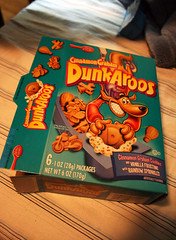
Ah, Dunkaroos. That is, a dual-chamber compartmentalized plastic snack container housing kangaroo-shaped cookies and sweet, sweet frosting. The marketing department at Betty Crocker clearly took a pretty literal approach with their concise yet didactic slogan: "You Don't Just Eat...You Dunk-a-Roo!" And Roos we did dunk. In fact, we dunked to with such zeal and fervor that a web search for "Dunkaroos" leads you to forum after forum where passionate Dunkaroo devotees discuss and debate the various black-market methods of procuring bootleg snacks from their 90s childhoods.

Yes, those were simpler times. These days, the current fanaticism surrounding this simple cookie-and-frosting snacktime combo impels Dunkaroo enthusiasts to scour amazon.com and discount stores to locate these discountinued delights. Whether chocolate, vanilla, or the late-era cookies and cream flavor struck your fancy, these were a kid's dream. Imagine, a conveniently packaged snack featuring absolutely no natural ingredients and negligible nutritional value.

For some inexplicable reason, this cookie-and-frosting combo was paired with a sharp-dressed and surprisingly formal Australian Kangaroo mascot sporting a hat, vest, and tie. You have to wonder what that marketing meeting was like:

"Alright team, we've got these cookies with a frosting dip. What's the logical leap for our big ad campaign launch? I say we go the Australian angle, you know how those Aussies love their prepackaged frosting-laden snacks. Better yet, let's make it a kangaroo with an Australian accent. That's more appropriate, really. And can we dress him up a bit? Let's be real here people, a kangaroo wouldn't just go about eating sweets bareheaded sporting shirtsleeves. That's it, a hat and tie will really emphasize the deliciousness."

Exhibit A:


Ahh...there's nothing like a half-sung, half-spoken painfully literal description of a snack food to get the hunger juices flowing.

Mascot aside (because let's be real, most of our childhood foods were actively promoted by randomly generated anthropormorphic cartoon rabbits, cavemen, leprechauns, and their ilk), Dunkaroos were a phenomenon. These were the food to pull out at snack time. Your cheap handi-snack knockoff cookies-and-cream pack were essentially an affront to the valid cookie and frosting snack community.

The most bizarre part was, at the height of their popularity, the Dunkaroos people launched a contest to replace their loveable if oddly matched mascot, Sydney, with...wait for it...another kangaroo. I know they're called Dunkaroos, but really. The parameters of this contest, endearingly titled the "Dunk-a-Roos Kangaroo Kanga-Who Search," essentially requested from their loyal fans the most incremental image change possible. I present to you, Duncan, the dunkin' daredevil. Like all other cartoon food mascots, the majority of his life is devoted to being thwarted by obstacles in an attempt to eat a food that the rest of us can just pick up in our neighborhood grocery store.


So there you have it...Dunkaroos. As their then new bad-boy mascot (as denoted by presence of backwards cap) rides into the abyss on a roaring motorcycle, so too must we leave behind this delicious snack from days of yore in a cloud of cookie dust. That is, unless you're willing to risk life and limb by ordering discontinued snack food on amazon.com for purely nostalgic reasons.

According to my google search, most of you are willing to take that risk. Dunk safely, children of the 90s. Dunk safely.

Thursday, June 10, 2010

Children of the 90s is at a Work Conference...In the Meantime, Please Enjoy this Classic Post: Doug

Children of the 90s is at a work conference this week with tragically limited internet and computer access. Take my word for it, it's totally tragic. I didn't want to leave my loyal readers in a bind, so I am pleased to present you from a classic Children of the 90s' post from way back when I was getting a whopping 14 hits a day.

I trust few enough of you have trudged through the extensive backlogs that this is almost like new. Almost. I should be back in full force by next week. Until then, enjoy the reruns! Hey, it's summertime. I've got to save the good stuff for sweep
s. Thanks for your understanding--see you next week!


That's right, we're talking Nickelodeon original-Nicktoon era, not the shoddy subpar imitation churned out by ABC/Disney after 1996. To embarrass themselves further, Disney awkwardly renamed the series Brand Spanking New! Doug, despite the fact that the show had already been airing on Nickelodeon 5 years. Their new title reeked of desperation, a sort of "look at us! We got that show you liked! Now watch us make it terrible."

Exhibit A, the more wisely re-renamed Disney's Doug:


Note the presence of unmatchable Disney inoffensive blandness, replacing the original lovability of the a-cappella theme song. Whistling? Really? And everyone standing there waving cheerily? A travesty indeed.

And before we move on, let us briefly discuss the mutual ridiculosity of fanatical fan Wikipedia updaters and absurdly miniscule visual changes made by the Disney animators to classify the show as "brand-spanking new!":

Character changes on Disney's Doug:

  • Doug's sleeves were longer and had a pair of black and white shoes instead of red and white.
  • Skeeter's shirt was altered from a yellow lightning bolt to a yellow "O".
  • Roger's leather jacket was sleeveless along with his hair combed down instead of his straight up hairdo on "Nick's".
  • Patti's hair was cut. Her shirt stayed the same, except she is wearing blue jeans instead of her blue skirt.
(from http://en.wikipedia.org/wiki/Doug)

You have to think to yourself, was there some sort of copyright sensitivity from the original series to the knockoff Disney version? What would possibly motivate them to sit around the boardroom, poring over storyboards, and heatedly debating the merits of cartoon haircuts and leather sleeves?

But anyway.


The real Doug was Nickelodeon's Doug, running from 1991-1995. The original series wasn't about long, complicated plotlines; each show was divided into two 11 minute "episodes" conducive to our limited childhood attention spans. It took all of our favorite cartoon cliches (lovable awkward protagonist, cute pet sidekick, quirky best friend, wacky family and neighbors, love interest, school bully) and made them into a virtual rainbow of bizarre multiculturalism. Sure, Doug was white, but his mother is inexplicably purple. And let's not even get started on how his best friend's name is "Skeeter". Clearly this was of an era before that term was imbued with inappropriate rap-song innuendo. We can only hope.

The originally show was both vividly and ridiculously imaginative in a way that was deeply resonant with our not-yet cynical preadolescence. Case in point, Doug's self-imagined alter-ego "Quail Man":


Yes! Amazing. An amazing way to add flashier nonsensical, nonsequitor plots. But we ate it up nonetheless, for its sincerity and resonance. My personal favorite foray into Doug's imagination was his fantasy music video of his "band":


I'm torn on which part is my favorite; the initial exclamation-in-unison accompanied by star-producing high-fives, or maybe the Doug-as-Michael-Jackson-with-ethnic-backup-dancers sequence. Either way, it was pure, unadulterated genius. To this day people acutally do live-action covers of this song on YouTube, if that speaks at all to its posterity.

In short, Doug did not insult our intelligence as children. There were all sorts of clever minor aspects of the show we can now appreciate as (theoretical) grown-ups. The "Beets" as a facsimile of the Beatles, his beatnik sister Judy's "Moody's school for the gifted," or Porkchop's igloo in the backyard.

So, to Disney: we will not accept your cheap, shark-jumping imitation. Giving Patti Mayonaise a butch haircut and naming Doug's new baby sister "Cleopatra" (really?) will never win us over. The original quirkiness of the show was what made it so endearing and enduring. It's what separated the authentic Doug from the later inferior imitation.

After all, how many of you can recall the lyrics from the Nickelodeon-era Beets' hit songs "I Need More Allowance" and "Killer Tofu"? Or Doug's fear of exposing his distaste for liver and onions to Patti? Or that Doug was horribly embarrassed of his middle name, Yancey?

On the other hand, how many of you can recall...well, anything from the Disney version?

I rest my case.

Wednesday, June 9, 2010

Children of the 90s is at a Work Conference...In the Meantime, Please Enjoy this Classic Post: I've Fallen and I Can't Get Up!

Children of the 90s is at a work conference this week with tragically limited internet and computer access. Take my word for it, it's totally tragic. I didn't want to leave my loyal readers in a bind, so I am pleased to present you from a classic Children of the 90s' post from way back when I was getting a whopping 14 hits a day.

I trust few enough of you have trudged through the extensive backlogs that this is almost like new. Almost. I should be back in full force by next week. Until then, enjoy the reruns! Hey, it's summertime. I've got to save the good stuff for sweeps. Thanks for your understanding--see you next week!


Looking for a surefire way to guarantee that no one will respect the precarious health of the elderly and to diminish the legitimacy of their tenuous medical state? Well, you're in luck! The Life Call corporation has already done it for you and has made it available in convenient late 80s/early 90s daytime television commercial slots. As the Life Call people sat around musing what was the possibly the way to least seriously depict the grave dangers associated with solo-dwelling senior citizens, they stumbled upon a foolproof formula for endless mockery and derision. How could we make light of such a tragic and serious risk? Well, I'll tell you how.

Yes, the Life Call people decided against working the "this is a serious life-saving product and should be presented as such" angle and instead opted to hire the campiest, chintziest elderly actors to produce embarrassingly low-budget dramatizations for their television advertisement. At least at the beginning, the fine print in the lower right-hand corner reads "dramatization". Whew, that was a close one. I was concerned that that woman had actually fallen and couldn't get up, and we were all just sitting around casually observing her in her dire state. At best, it was as if Life Call had raided a retirement home community theater troupe. Obviously, they had already blown their whole legitimate actor budget to hire concerned-looking family members and friends of the injured party. Thankfully, those characters had no lines or maybe we would have taken this thing less lightly.

Here is the ad, in all its glory:


Less widely mocked was the first guy, Mr. Miller, who acts his heart out (possibly, literally, considering his supposed ailment) describing his chest pains. However, our real heroine was Mrs. Fletcher, oh great utterer of redundant and unintentionally humorous phrases. The fictional Mrs. Fletcher croaked out a line that exceeds nearly any quote out of Bartlett's in immediate recognizability.

"I've fallen...and I can't get up!"

It was probably that second part that did in poor Mrs. Fletcher. Laying on the floor of her questionably empty room, walker askew, we could all clearly deduce that she had indeed fallen. Her apparent need for the Life Call system suggested to us that she was also likely unable to get up. Otherwise, she probably would have called up and said, "I've fallen! ...Oh, no, I'm fine, I'll get myself up in a jiffy. I just wanted someone to talk to because I'm lonely and live alone and can only communicate with my children, neighbors, and doctors through third party Life Call employees." But no, Mrs. Fletcher knew better than that. She had to do more than just explain that she had fallen, that part was clearly evident to any impartial observer. She needed to fully elucidate her situation by pointing out that not only had she fallen, but that she was at the same time unable to get up. Well, bless her heart, she certainly sold that line. Unfortunately, to children growing up in the 90s, it was probably the funniest thing that they had ever seen and/or heard.

We had all been told dozens of time to respect our elders. Parents and teaches explained to us that most senior citizens are viable and capable and deserve to be treated as human beings. We all bought that for about ten minutes, or at least the time elapsed between receiving that explanation and our initial viewing of the Life Call commercial. Though the commercial was marketed toward seniors as a tool to encourage their independence, to us it only cemented their status in our eyes as highly dramatic, accident-prone victims.

As if Life Call hadn't hammered the point home enough already with their melodramatic dramatizations, they also relied on the cheery host of the commercial to explain to us what we had just seen. "See?" She prompted condescendingly. "Protect yourself with Life Call and you're never alone!" For those of us unable to understand the complex plot twists and the nuanced acting of her preceding ad castmates, we could always rely on our Life Call pendant-sporting pal to restate the thesis of the commercial. And wasn't she recently "deathly ill"? Why, she looks great! We can only imagine that if it hadn't been for been those dashing pseudo-cop outfitted Life Call operators, her deathly illness would have led to, well, death.

Obviously at some point, Life Call realized their gaffe and sought a new direction with their advertising campaigns. No longer were they going to be victims of endless mockery. They were going to take a hard line with customers and depict true stories of Life Alert's life-saving capabilities:


Wait a minute. Didn't she just say she wasn't an actress? Well, then why is she being played by one in the dramatization? We thought you had seen the error of your ways, Life Call, but this dramatization of supposedly real-life events featured the same catchphrase as the original. Are we really to believe that this real live woman had seen the Life Call commercial so many times that she instinctively uttered their trademarked line to operators? Also, are to we to buy that someone with the foresight to purchase a Life Call Emergency Alert System was engaging in such irresponsible fall-prone behavior as reading a book and walking? At the same time? And another thing! Aren't those the doctor and telephone operator from the first commercial? Are you telling me we're using stock footage because we couldn't even afford to hire some new actors? You can even hear the choppy way they cut off the "Mrs. Fletcher" part of the operator's line to accomodate this allegedly new true story. Way to go, Life Call. You really caught yourself with that one.

Then again, their intention was not to catch themselves; it was to catch poor clumsy Mrs. Fletcher, or this new supposedly real-life non-actress knockoff of Mrs. Fletcher.

After all, they were the ones who had fallen.

Tuesday, June 8, 2010

Children of the 90s is at a Work Conference...In the Meantime, Please Enjoy this Classic Post: Ghostwriter

Children of the 90s is at a work conference this week with tragically limited internet and computer access. Take my word for it, it's totally tragic. I didn't want to leave my loyal readers in a bind, so I am pleased to present you from a classic Children of the 90s' post from way back when I was getting a whopping 14 hits a day.

I trust few enough of you have trudged through the extensive backlogs that this is almost like new. Almost. I should be back in full force by next week. Until then, enjoy the reruns! Hey, it's summertime. I've got to save the good stuff for sweeps. Thanks for your understanding--see you next week!


Ah, the joys of good, clean multicultural middle-school student supernatural detective work. The television series Ghostwriter, which ran 3 seasons from 1992-1995, was a thinly veiled effort by public television to encourage the development of basic reading , writing, and problem-solving skills among elementary school children. We may have had no idea at the time, but watch an episode now and you will find the educational components are blindingly obvious. The show was remarkably good at tricking us into learning, as well as providing all sorts of feel-good moral lessons along the way.

The show's characters were the live-action equivalent of the names and pictures textbook publishers use to vociferously and repeatedly tout their commitment to racial and ethnic diversity. Though I can recognize this show aired during the blooming of the age of political correctness, they laid it on pretty thick. We couldn't just have a group of relatable middle-class white kids running around solving mysteries. Instead, it was necessary to produce some variation of "We are the World," the children's television series:


That intro shines so brightly with quintessentially nineties special effects, it makes you want to reach for the Vanilla Ice Gautier shades. The cast all seem remarkably surprised to see their names, though I assume they were told by the crew that they were filming the intro.

The premise of the show involves a mysterious unseen "ghost" (represented by a jumpy glowing light) who communicates with the Ghostwriter team by manipulating words and letters in the kids' everyday settings. The team quickly learns that a mysterious spirit has opted to communicate with them through the handily educational use of their reading and writing skills. While this ghost could likely have chosen all sorts of qualified, highly educated people to do his bidding, he insists on using elementary and middle-school aged children to solve his inoffensive and conveniently child-friendly brand of mysteries.

The "team" members, united by their common ability to communicate with the mysterious Ghostwriter, denoted their membership by wearing a special pen on a cord around their necks. That's right, as if they could not shove the educational component down viewer's throats any further, the team's all-powerful ability lay in their ability to write. I wouldn't call it a subtle metaphor, but hey, it worked.

Of course, just like real-life children, they had freakishly neat typewriter-grade penmanship and wrote at the slowest possible pace to ensure that their young viewers could actually grasp what was happening. Fortunately for those with limited literary prowess, each story arc took a remarkable four or five half-hour episodes to solve. Especially in a time before rampant over-prescribing of attention-deficit medications, it's nearly inconceivable children actually mustered the attention spans to follow a single mystery storyline over a weeks-long run. Ghostwriter clearly had some form of hypnotic power over its viewers, as the show was spectacularly popular throughout it three seasons.

Ghostwriter was not merely a television series; it was an educational franchising powerhouse boasting CD-ROMs, books, VHS releases, classroom curricula, and of course, replica Ghostwriter pens so viewers at home could "play along". I never had any luck solving the mysteries, but I do have a mini Lisa Frank notebook somewhere full of all of the clues tirelessly scribbled in admittedly poorer-than-Ghostwriter-team penmanship.

There are hundreds of Ghostwriter episodes floating around on the internet today, but I leave you with the original. As if you were not already convinced that Samuel L. Jackson is in every piece of motion-picture media every produced, he also plays Jamal's father in Ghostwriter. I present to you the first episode of Ghost writer, "Ghost Story:"


Link to exhausting log of Ghostwriter episode synopses:
TV.com guide

Monday, June 7, 2010

Children of the 90s is at a Work Conference...In the Meantime, Please Enjoy this Classic Post: Scholastic Book Orders

Children of the 90s is at a work conference this week with tragically limited internet and computer access. Take my word for it, it's totally tragic. I didn't want to leave my loyal readers in a bind, so I am pleased to present you from a classic Children of the 90s' post from way back when I was getting a whopping 14 hits a day.

I trust few enough of you have trudged through the extensive backlogs that this is almost like new. Almost. I should be back in full force by next week. Until then, enjoy the reruns! Hey, it's summertime. I've got to save the good stuff for sweeps. Thanks for your understanding--see you next week!


There was no day like book-order day. It's crazy to imagine that book-order forms really drove the kids wild, but the love of these flimsy little pamphlets was irrepressible. Despite the fact that these books were available at local retailers everywhere, the idea that something would come to us in the mail at school and we could spend weeks anticipating it was almost too much to bear.

The best thing about book orders was not the order forms themselves, but rather the accompanying excitement of the purchase. Imagine, as a child, being able to select and buy something all on your own! Sure, your parents would have to fill out the form, write the check, and seal the envelope, but you brought it to school. The books arrived with a post-it with your name on it! Let's face it, as children we weren't big decision makers. We couldn't choose what we were going to eat for dinner or what time we would go to bed, but dammit we could pick our books and that was that.

Never mind that these books were educational. We usually found ways around that. There were always special "just for fun" books with no educational value whatsoever, and we hungrily devoured them. I specifically remember ordering a Full House Uncle Jesse's personal photo album. Just imagine! I, a mere third grader, could own Uncle Jesse's personal collection of photographs! In the days before I possessed the mental capacity to realize these "albums" were mass-produced, I actually believed that I owned a piece of history. Through my own good luck, book orders had allowed me to stumble upon a collection of pictures that Uncle Jesse had decided to mail to me and me alone! Take that, third grade peers!

Now of course we can look past our childhood frenzied enthusiasm to realize that at its core, Scholastic was really just a master of marketing to children. By distributing these in schools allowing the children to see these forms first, they put the kids in control. It was like programming children to pester and torment their parents until they finally gave in and wrote the check.

But in those days, we didn't see it that way. Aside from the obvious gratification of Christmas-morning-esque book-order deliveries, bringing in your book-order with all the right books checked off was a measure of your playground street cred. These book orders were ours, and we called the shots. As children, our level of autonomy was pretty limited, so we took it where we could get it.

And if where we could get it also threw in a boxed-set of Judy Blume books, it just made it all the sweeter.


Book-Orders in the news:
Book Orders Under Fire

Browse online Scholastic book-orders:
Book Orders Online

Friday, June 4, 2010

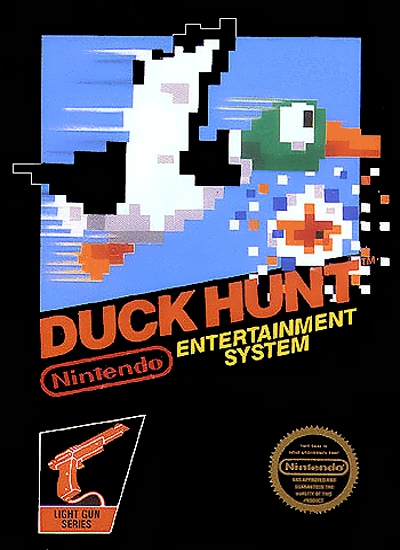
Duck Hunt


It's official: today's video games are way too realistic. The other day I foolishly opted to play some Big Buck Hunter at a local bar, leading to my inevitable cowering at the prospect of repeatedly killing deer that bore ab eerie resemblance to Bambi's mom. What happened to the days of blurrily pixelated hunting? I don't think I could ever shoot a real live deer in the face, yet I'm more than gleeful for a shot (pun intended) at some Duck Hunt mallards or lethargic bison in Oregon Trail. What? I don't want that dog to mock my haul, nor do I want to face the embarrassment of having caught so few pounds of meat that it actually fits in my covered wagon. It's a legitimate justification.

With a sufficient proportion of pixelated non-realism coupled with a totally fake looking red plastic gun, even the most squeamish shooters among us were wont to take out an entire flock in a single round. Old school Nintendo knew a thing or two (in retrospect, I'd say two) about the notion of less is more. The game was incredibly repetitive, requiring us only to shoot at a duck or two per round and to avoid shooting the dog. It may not have held the attention of today's overstimulated child, but many children of the 80s and 90s lost great stretches of time--not to mention the ability to focus our eyes--to this simple electronic endeavor.

In comparison to the shooting games available on today's video game market, Duck Hunt was incredibly tame. Our duck victims never bled profusely from their gaping wounds nor did they ever shake a mangled wing at us while accusing us of poultricide. In fact, we had almost no interaction with them at all. They simply flew overhead to the mesmerizingly hypnotic music, we shot at them, and our loyal canine companion retrieved their abandoned carcasses. No fuss, no muss.


Of course, it wasn't all invisible off-screen blood and guts as we appraised our killing streak. We also had a chance to shoot skeet, which thankfully had no R-rated double meaning to us at the time. The eruptions of clay pigeons in the air was not especially differentiated from the hunting of live ducks, thanks to the primitive mid-80s gaming graphics technology. Whether the bullet contact induced an exploding gray circle or an exploding purple and white circle with wings, it all sort of blended into a generally gore-free exercise.

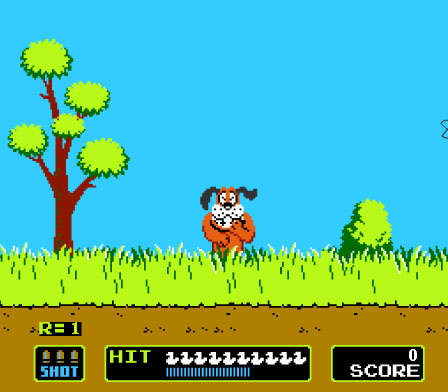
That dog, though, could have used some serious etiquette training. In fact, many bootleg versions of the game enable the player to shoot and kill the dog, fulfilling the fantasy many of us constructed after enduring his endless merciless taunts at our shoddy aim. You shoot, you miss, the dog mocks you profusely. It was more than enough to grate on our fragile young egos. Plus, he was incredibly annoying. I admit to aiming the gun at him once or twice, but unfortunately in the official game, there's just no getting rid of him.


No matter how easily amused we claim we may have been as children, there's no true justification for having played this game for more than 20 minutes at a time. It is so utterly mindless, prolonged playing may begin melting the softer areas of your brain. There is, indeed, an object to the game: shoot anything that moves; however, that's not quite enough of a motivating premise to keep us engaged for hours a la Super Mario Brothers or Tetris.

Duck Hunt's popularity can be credited to its bundling with the Super Mario Brothers game, both of which came with the classic Nintendo Entertainment System. While Duck Hunt probably couldn't stand alone as a bestselling game, it enjoyed widespread de facto popularity for one reason: because it was there. The plastic gun was still a bit of a novelty for an at-home gaming system, so it didn't matter much to us that the game was a simple exercise in point and shoot. We point, we shot, we outsmarted that damn dog.

It certainly didn't attain the same cult following as its bundle-mate Super Mario Brothers, but Duck Hunt achieved a quiet iconic status by default. Whether or not you were a fan of the game, if you owned an NES, you probably owned Duck Hunt. I still can't see that little red plastic gun without itching to take out some 8-bit fowl. I may not have ever developed the killer instinct, but this family friendly take on a shooting game made the genre palatable to even the wussiest of young gamers. See, sensitive kids can kill things, too! Thanks, Nintendo.

Thursday, June 3, 2010

Buffy the Vampire Slayer


All of the screaming teenagers out there today who think Twilight is a pioneer in the adolescent vampire genre should really brush up on their 90s TV trivia. Of course, in our day, high school girls weren't quite so impressionable; it was pretty rare for one of them to even entertain a flirtatious relationship with one of these bloodsucking demons, let alone embark on a full-scale whirlwind romance. No, we kept it simple in the 90s. You find a vampire, you slay it. It was just that easy.

Call me a purist, but as someone who has yet to actually give any of the Twilight series a try (for fear of spiraling back into screaming tweenish obsession), I prefer a clearer good versus evil divide. I like to know who is on which side. In Buffy world, vampires are bad, slayers are good, and there's not a lot of room for gray area. Well, okay, except for Buffy's tryst with Angel. Oh, and then it turns out he's a good guy and gets his own spin-off. You know what? I retract my previous statement. It's pretty darn similar. Apparently the appeal of predominant supernatural teen themes stretches across generations. Who knew?

In Buffyland, though, vampires the only bad guys. In her television incarnation, Buffy and the gang had plenty of evil nemeses to battle throughout the series, including but not limited to demons, sorcerers, witches, mutants, and bad-guy little league coaches. That's what you get for building a high school on top of a portal to hell. For many of us, high school was a hell without all of the escaped demons and crazed wizards, so we can only begin to imagine the horror of actual dark forces at play in the midst of our search for the perfect prom date.

The television series was not the first step in the Buffy enterprise; The franchise was born in 1992 as the eponymous comedy horror film starring Kristy Swanson and Luke Perry. In the considerably lighter movie, Buffy is introduced as a traditional popular blond cheerleader stock character--also known as a stereotypical horror movie victim. Creator Joss Whedon subverted the blond-girl-screams-in-dark-alley-and-is-torn-to-shreds horror trope, though, by making Buffy into a strong-willed, self-sufficient warrior. Or at least that was his intention. In the film version, some things did get a bit lost in translation through the editing process, but luckily Whedon got a second crack at the story.


Buffy's TV incarnation transferred her to Sunnydale, California, home of the aforementioned hell portal high school. Charming, no? The show held true to the basic premise of its preceding film, but the tone changed significantly with the shift to the small screen. While the film version of Buffy the Vampire Slayer had a tongue-in-cheek lightness to it, the television adaptation had a distinctly darker feel.

While the show maintained the same general premise as the movie, many details were altered to better suit the new format. Creator Joss Whedon had been less than pleased with the re-tweaking of his original script, lamenting the transformation of his horror movie into a fluffier comic film. When presented with an opportunity to adapt the concept for a television series, Whedon retooled the show to more closely match his original vision. In turn, the show ended up picking up at a slightly different point than the movie left off, but it was a shift that brought in a broader fan base.


The TV series saw our heroine and her friends through the gamut of typical teenage problems with a major twist: the demons they battled weren't only their identity and social stature, but actual live demons. Talk about hammering a metaphor to death. It's certainly a device that could have come across to viewers as trite and hackneyed. In practice, though, Buffy's emotional struggles were handled skillfully in their translation to external battles.

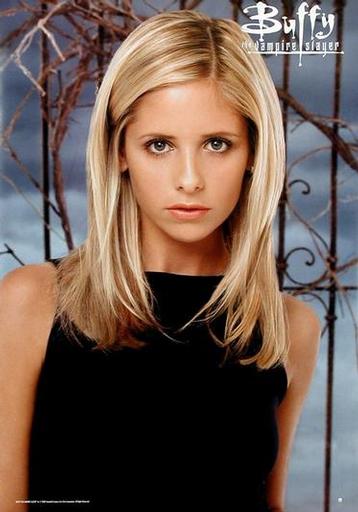
Lucky for TV Buffy, she didn't have to slay alone. Buffy (Sarah Michelle Gellar) had a crack team of teen sidekicks called "The Scooby Gang." The Scoobies include Willow (Alyson Hannigan), Xander (Nicholas Brendon), and occasionally Buffy's benevolent "Watcher" Rupert Giles. The gang expands significantly over the show's run, growing to include character's like Buffy's younger sister Dawn (Michelle Tratchenberg) and former high school nemesis Cordelia Chase (Charisma Carpenter.) While Buffy is the only true "Slayer", her gang of sidekicks help her considerably in her mission to take out evil, whether through their own powers, their knowledge of their former lives as demons or bad guys, or some other generally awesome qualifying factor.

Buffy the Vampire Slayer gradually acquired a rabidly devoted fan base, beginning the show's run with meager ratings and snowballing into a teen phenomenon. Buffy made a major ratings contribution to the then-fledgling WB network, bringing in hordes of adolescents viewers. The show remained successful throughout its run on the WB, but negotiation disputes landed Buffy on UPN in its sixth season. While the series retained a good deal of its initial popularity and had acquired an extremely loyal group of fans, by its seventh season it seemed to have run its course.

True to Whedon's original vision, it was refreshing to see the young blonde protagonist as a strong proactive force instead of as a meek helpless damsel in distress. It's nice to see a horror film where the adolescent girl finally gets to kick some supernatural butt. Unlike many other superheroes, Buffy was largely just a normal girl who fell into the role of protector of the universe. Hey, it's a tough job, but someone had to do it. If you're still hungry for your Buffy fix, don't worry; Joss Whedon was kind enough to expand the official canon to include a "Season 8" comic book. It's not quite the same as watching the live action unfold onscreen, but it will do in a pinch.

Wednesday, June 2, 2010

Sesame Street Songs

Some children's entertainment is timeless. If well-executed, a children's show or song has the potential to amuse and engage children across the span of generations. Admittedly, the fact that children are incredibly easily won over may play a part in the perseverance of these songs; most kids tend not to be especially discerning in their taste, nor do they have even a remote sense of what is irritating. Not to mention the fact that many parents are too cheap to replace the old hand-me-down CDs and videocassettes over the years--I know that kept my family watching scratchy VHS tapes for years after their prescribed shelf life had expired. Why buy a new copy of "Follow That Bird" or "Sing the Alphabet" when the original is still in working condition? Exactly.

Whatever the reason for its perseverance, Sesame Street has captured the hearts of children from the 1960s on and its appeal to each subsequent generation has remained strong. The show's music that drew in children in the 70s often remained beloved by children of the 90s and beyond. Many of the versions seen below are from the 70s but have been since replayed or re-recorded for new young viewers. The songs are extremely catchy and make for easy sing-alongs--perfect for children, but as an adult, it occurs to me they would be perfect for my iPod as well. Excuse me for a moment--I'm off to iTunes to add "Put Down the Ducky" to my road trip playlist.

As is the case in everything you see here at Children of the 90s, memory is subjective. Songs that stand out as my favorites probably differ somewhat from your own, so share your own most memorable Sesame Street tunes in the comment section. In fact, you could even link to a video of the song so we can all reminisce along with you! Sound like I'm asking you to do my job? Possibly. I asked nicely, though, so I think we can let it slide.

By the by, if you're looking for your favorite Sesame Street famous musical guests, fear not; I haven't forgotten them as a blatant omission. I've already got a whole post devoted to them. Check it out. See, I'm not so lazy as I might have seemed when I asked for your contributions to this list. I accept your apology for the snap judgment. Don't worry about it.


Rubber Duckie


Now here's a song with some serious mass appeal: in 1970, Rubber Duckie actually charted at a peak number 16 on the Billboard Hot 100. Not too shabby for a song intended to encourage children to bathe.


C is for Cookie


Ah, how we long for the days when Sesame Street's favorite cookie addict was still allowed to freely extol the virtues of sugar-laden snacks. While Snopes has since discounted the raging internet rumor alleging a switchover from Cookie Monster to Veggie Monster, our furry blue cookie consumer doesn't seem quite as ravenous for sweets as he once did. In my day, C was for Cookie and that was good enough for me.


Elmo's Song


Play this one at your own risk. I'm telling you, once it's in there, there's no removing it from your brain. It's entirely likely you will spend at least 24 hours repeating the "La la la la, la la la la, Elmo's soooong" chorus over and over again in your head. Elmo draws you in with his benign cuteness and then BAM! Total cerebral takeover. Well played, Elmo. Well played indeed.


ABC-DEF-GHI


Oh, poor, misguided Big Bird. He sees the alphabet written in chalk on the sidewalk and jumps to the conclusion that it's a long word with a meaning known only to the wise. Children without a comprehensive knowledge of the alphabet are probably equally perplexed by the meaning of "ab-cer-def-gee-jeckle-mernop-kur-stoove-wik-siz," but hopefully they can deduce that they possess an intellectual potential superior to Big Bird and figure it out eventually.


Bein' Green


This song gave Kermit a bad rap for melancholia--his lament of his green hue does seem like a bit of a downer. Apparently a major proportion of child viewers failed to understand that he actually felt okay about being green by the end of the song. That's what you get for trying to engage children through subtlety: total misunderstanding.


Put Down the Duckie


Hoots the Owl tells it like it is. Ernie naively thinks he can play the saxophone while clinging to his dear rubber duckie, but he is sadly mistaken. I suppose you could deduce some sort of anti-materialism message from the song, but most kids probably learned only not to attempt to play the saxophone while holding a small yellow rubber duck.


Sing


"Sing" remains one of the most-sung songs on Sesame Street, which is nearly as impressive as how many versions of the word "sing" I managed to squeeze into this sentence. The Carpenters' cover in 1973 even hit number 3 on the Billboard charts. It's since become a Sesame Street standard; perhaps there's some guest star initiation clause that requires celebrities to churn out a version of "Sing."


The People in Your Neighborhood


This one could possibly stand to be updated for the current decade; the people in our neighborhood have expanded to include the digital cable installation man and the guy in India allegedly named "Mike" who talks us through our Windows 7 installation. That's not to diminish the importance of the postman and the fireman, of course. It's far more likely that kids will still have aspirations of growing up to be one of those than an outsourced technology customer service associate.


I Love Trash


There's not really a "message" in this one, per se, but it stands alone on cuteness. That is, if you consider a garbage can-dwelling monster waxing poetic on the virtues of a good broken telephone or rusty trombone to be "cute." For the record, I do.


I Don't Want to Live on the Moon


Like Ernie, I too feel that I'd like to visit the move, but setting up permanent residence seems like a mistake. That's the lesson here, right? An anti-gravity locale is a tough full-time homestead? Okay, okay, fine, maybe it has something to do with appreciating what you have here at home. Darn you, Sesame Street, and your resonant life lessons.


Monster in the Mirror


We could all take a page from Grover's book: rather than being frightened by the monster in his mirror, he chooses to befriend it. To be fair, he is that monster, but I'm sure there's a nugget of educational wisdom in there somewhere. I think it's hidden in the "Wubba, wubba, wubba, woo, woo, woo" section.


Ladybug Picnic


Learn how to count and delight in watching ladybugs engage in adorable picnic activities? Where do I sign up? Of course, not all of the lyrics are totally relatable for small children. That line about the ladybugs' conversation about the high price of furniture and rugs and fire insurance for ladybugs may have gone a tad over their heads, but luckily they were distracted by the cute animation.

Tuesday, June 1, 2010

Children of the Nineties One-Hit Wonder Mash-Up : 1999


We're still working our way (albeit extremely gradually) through the one-hit wonders of the 1990s. Up today: 1999, a glorious year for wildly popular songs from a group of artists who for the most part quietly faded into obscurity. 1999 was particularly ripe with one-hit phenomenons, giving us some of the most memorable and inexplicably bizarre top-charting hits of the decade.

In many of these cases, it's more than clear why an outrageously top-selling follow-up was not in the cards for these performers. The general public felt we have heard more than enough from many of these artists; without this sentiment, we may have been subjected to such unnecessary hits as "Green (Do Bee Do)." No thanks.

That said, a few of these acts seemed fairly promising and capable of a long career. For whatever reason, though, even the legitimate musicians among this group have since been relegated to has-been status--at least in the eyes of the pop music charts. It's a tough business, but hopefully they're still milking the royalties from their ubiquitous play in grocery stores and dentist offices. We can only hope.


B*witched: C'est La Vie


Just from the intro, you know this song doesn't take itself especially seriously. The Irish girl group begins their top-charting hit with the spoken exchange, "Some people think I look like me dad," "What? Are you serious?" Brilliant. It's all uphill from here though, from the Three Little Pigs huffing and puffing wolf reference to the ultimately necessary traditional Irish music dance break.


Lou Bega: Mambo No. 5


Lou Bega's cover of Perez Prado's 1949 jive hit quickly shot to popularity, resulting in innumerable parodies of the song's lyrics and structure. None, though, perhaps as ridiculous as the version Lou Bega himself recorded for the G-rated Radio Disney cut. There's no real words to describe the ridiculousness of replacing "liquor store" with "candy story" and extolling the virtues of "A little bit of Minnie in my life/A little bit of Mickey by her side."


Everlast: What It's Like


Ah, now here's a pick-me-up--the story of a beggar outside the liquor store, a pregnant teenager contemplating abortion, and a violent-prone guy with an alcohol problem. Everlast sang the blues over mainstream society's indifference to the plight of the less fortunate. A legitimate and powerful message, no doubt, but not exactly the cheeriest song to top the 1999 charts.


New Radicals: You Get What You Give


"You Get What You Give" is a classic upbeat ode to youth culture, featuring a classic "be yourself" feel-good message. No matter how many times I listen to this song, I've yet to accomplish the difficult feat of actually memorizing all of the lyrics. To this day, the extent of my ability to sing along with this song is, "Fashion shoots with Beck and Hanson, Courtney Love and Marilyn Manson....[unknown]...we'll kick your ass in!" I know there's got to be more than that, but my brain is clearly not wired to remember it.


Eiffel 65: Blue (Da Ba Dee)


Of all of the strange one-hit wonders out there, this has to be one of the strangest. It really pushes the rationale of quality equals popularity for mainstream music. "Blue" truly a difficult song to defend on the basis of quality, though its undeniable catchiness is no doubt the foundation of its rise to fame. It's a serious earworm; one listen and you're destined to be humming this one all day.


Eagle-Eye Cherry: Save Tonight


There's something uniquely appealing about a song with a highly repetitive chorus and lyrics. Eagle Eye Cherry managed to repeat the words, "Save tonight" and "Tomorrow I'll be gone" so many times that they will be forever burned into our memory centers. Oddly enough, I have heard "Save Tonight" numerous times over the past few years sung as a campfire song. Perhaps the simplicity of the chords is to blame, but I can't say I saw that one coming a decade back.


Baz Luhrmann: Everybody's Free (To Wear Sunscreen)


Yes, the directorial force behind Romeo + Juliet and Moulin Rouge is the voice of the "Wear Suncreen" song. The song was adapted from a Chicago Tribune column geared toward giving the class of 1997 some "advice, like youth, probably wasted on the young." An urban legend sprung up that the speech was one given as a commencement address by Kurt Vonnegut, a rumor that bore no fruit but spoke volumes about the power of the internet to pull stuff out of nowhere.


Shawn Mullins: Lullaby


Here's another song that shows a song doesn't need to be all sunshine and smiles to top the charts. Shawn Mullins' melancholy tone resonated well with listeners and made for an easy sing-along with its chorus of "Everything's going to be all right, rock-a-bye, rock-a-bye." To this day, I still think of LA as "Nashville with a tan." Thanks, Mullins.


Vengaboys: We Like to Party


"We like to party, we like to party, we like to party, we like to party....We like to party! We like! We to party!" With lyrics like those, how could you not have a hit on your hands? It's tough to imagine the endless laborious hours that went into crafting the perfect words to express the Vengaboy's fondness of partying. Luckily, they had the Vengabus as an apt setting for making the magic happen.


Tal Bachman: She's So High


Whenever I worry about how I measure up to someone potentially superior, I simply use the following litmus test: Is she like Cleopatra? How about Joan of Arc? Any similarities to Aphrodiiiiiiiite? If so, she's probably pretty high above me. A foolproof system.


Len: Steal My Sunshine


If you're looking for a light and fluffy summer song to play out by the pool, "Steal My Sunshine" ought to shoot to the top of your list. It's airy and fun with little substance, making it a perfect choice for a poolside song. I'm still at a loss for the meaning of Len's album title, "You Can't Stop the Bum Rush." Maybe some Canadians out there can enlighten me, but I've always assumed it translates to exactly what it sounds like. Gross.

Friday, May 28, 2010

A Little Stick Stickly to Hold You Over for this Long Weekend


Happy Summer, y'all! In the spirit of summertime laziness, Children of the 90s is going on vacation a day early. Don't worry, I'm not going to leave you totally high and dry. I will never let my own laziness stand in the way of you getting your prescription-strength daily dose of 90s nostalgia.

As the major pervasive theme around here this week has been summer (and, for some reason, Sister, Sister--I just got creative) here's a lovely little slice of 90s Nickelodeon summertime greatness. I'm proud to present Nick in the Afternoon popsicle stick icon Stick Stickly in his very own half hour special, "Oh, Brother!" I can safely place it in my top ten full-length popsicle stick starring made-for-TV specials. Okay, maybe top eleven. Either way, it's pretty cute. Enjoy!


That's all I've got for you on today--it's vacation time. Well, technically, stay-cation, but there will be pool sessions and barbecues aplenty. If any of you are lucky enough to be going on vacation for this long weekend, feel free to brag about your plans in the comments section to make the rest of us very, very jealous. Have a great Memorial Day weekend (to those of you in the States) and we'll see you back here Tuesday!

Thursday, May 27, 2010

Outdoor Toys of the 80s and 90s

If you're a regular reader, it should be pretty clear your loyal 90s nostalgia chronicler has a serious case of summer fever. As we close in on Memorial Day weekend, the prospect of summertime fun is almost too much to bear. Granted, I don't have any water balloon fights or Jart tournaments scheduled, but the notion of sunshine and the great outdoors still elicits a childlike level of euphoria. For the record, my weekend is still open for Jart tournaments if you're interested in setting something up.

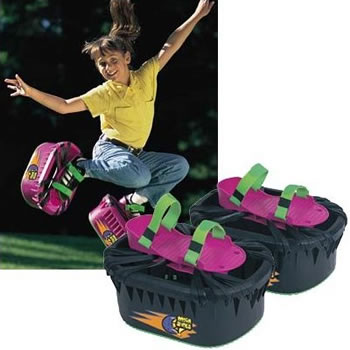
It's a safe bet to say we will never fully recapture that childhood school's-out-for-the-summer level of excitement; there is simply no adult equivalent to that level of anticipation. All the Moon Shoes in the world couldn't eliminate the grown-up stressors we face year round. Though, to be fair, I imagine it would help. Open reader plea: send Moon Shoes. That is all.

Though we may not be able to reignite the spark of summer vacation excitement, we can at least reminisce about some of the toys that made our summertimes so special. If you're lucky, maybe you still have some of these items lying around. Seriously, what I wouldn't do for a Skip-It right about now. Forget the gym membership--that little pink piece of plastic is way more motivating exercise.


Skip-It


Who could have foreseen that strapping a little plastic ball and chain to your ankle could provide hours of endless entertainment? That little progressive counter on the side tapped into the competitive child psyche, allowing us to compete against our friends and our own personal bests while playing quietly in the driveway. I imagine our parents were thrilled for the long-stretches of easily amused and generally exhausting play.


Rollerblades

Kids today may not believe it, but many of us were around for a time when rollerskates were still the gold standard in wheeled footwear. Inline skates were modeled after ice skates, intended for training use on dry land. Soon they were all the rage, a trend from which many of us learned the value of a deeply skinned knee. Regardless, rollerblades will forever be superior to today's alternative. Don't even get me started on those wheelie sneakers. Every time I see a kid rolling by me at the mall, I yearn to buy him a pair of rollerblades. They just don't know what they're missing.


Moon Shoes


The advertisements for Nickelodeon moon shoes were everywhere, though I never actually knew anybody that owned a pair. Had I been better connected on the playground, perhaps I could have experienced the wonder of spring walking firsthand. Alas, I will never know the gravity-reduced wonder of moonwalking. Until that whole colonization thing goes down. Or maybe if I become a great Michael Jackson-style dancer. Either way.


Super Soakers


One of the most effective ways to beat the summer heat is with a water fight, and we all know the key to winning a water fight lies in the proper arsenal of weaponry. Armed with our Super Soakers, we could outblast flimsy conventional water guns. In case you're not big on Super Soaker trivia, you may be interested to know they were originally branded as Power Drenchers. Or maybe you won't be. Who knows. Either way, the toy makers obviously got their hands on a thesaurus somewhere down the line.


Power Wheels


These much-coveted but oft-denied overpriced mini vehicles undoubtedly caused many temper tantrums over the years. We just couldn't understand why our parents wouldn't shell out the big bucks for one of these babies. If only I'd gotten the mock motorbike I wanted, I could be a bona fide Kawasaki ninja by now. At the very least, I'd hold a chance at being a proficient Barbie Jeep operator.


Nerf Balls
Finally, a company that recognizes kids throw things at one another and it can really, really hurt. Through the clever use of foam, the quantity of bruises per square inch decreased dramatically. Getting hit in the face just got that much more bearable. Thanks, Nerf!


Little Tykes Cozy Coupe


Here's a fact you might not know about your favorite child-sized vehicle: In the early 90s, it was reported that the Cozy Coupe had outsold both the Ford Taurus and Honda Accord, making it one of the bestselling cars of the time. It's certainly more economical than a Taurus or Accord, plus it gets way better gas mileage. The downside? Sore feet from all the Flintstone-style acceleration. You can't win 'em all.


Lawn Darts (Jarts)


Ah, finally a toy that combines the tranquil peacefulness of lawns with the terrifying risk of death by impalement. I'm not sure how or why these toys ever eked past the watchful eye of safety experts and parent groups, but somehow they made it into production and onto toy store shelves. It wasn't long before the US and Canada issued a ban on the sale of Lawn Darts and urged consumers to "discard or destroy them immediately." Yikes.


Slip n'Slide


Speaking of dangerous yard toys, here's a classic example of how innocent concepts can go very very wrong. I'll give you a hint when setting up your own slip n' slide: try your best to avoid cement or a downhill descent into a wall/sidewalk/pile of jagged rocks/any other bone breakin', tooth chippin' slide stopper. It sounds like common sense, but you may be surprised how many people failed to consider the consequences until their child was hobbling around in a cast or sling for the remainder of the summer.

Also, note to college students: It may seem like a good idea to combine a slip n' slide with alcohol. It is not. Believe me. Resist your instincts. Your limbs will thank me.

Wednesday, May 26, 2010

Sister, Sister


There's something endearingly familiar about oft-recycled story lines. If you've seen one separated-at-birth-identical-twins-reunited-by-random-circumstances story, you've seen them all. Suffice it to say if you're vaguely aware of The Parent Trap, you're more than well-versed in the gimmick behind Sister, Sister. It may not be the most original plot foundation, but the audience is usually so mesmerized by the appearance of two identical individuals that we overlook the hackneyed premise.

As in most identical twin-themed entertainment, Tia and Tamera are cast as polar opposites a la Jessica and Elizabeth Wakefield. It seems writers are generally unaware that twins can have anything at all in common. If one is studious, the other has to be social. If one is a deep thinker, the other must be a bit superficial. It's simply the balance of the universe; audiences simply can not comprehend any twin trope outside the basic identical opposites scenario. There's a reason very few shows feature fraternal twins or identical twins with similar interests: they just don't provide enough zany situationally comedic material.

Sister, Sister premiered in 1994 on ABC, lasting a single season on the major network despite its relative popularity. Following its swift cancellation, it was picked up by frequent television show rehabilitator and scrap feeder The WB. The show remained popular in syndication long after its final cancellation in 1999, airing on The Disney Channel, UPN, and most inexplicably, the Gospel Music Channel. Thankfully, the GMC saw fit to edit subjectively suggestive and/or mildly offensive from their broadcast, omitting phrases like "Shut up." Praise the lord.

The pilot episode introduced us to Tia Landry and Tamera Campbell, two unassuming 14-year old girls living in socioeconomically disparate parts of the Detroit, Michigan area. The twins were both adopted at birth by a convenient-to-plot single parent, Tia with sassy mother Lisa and Tamera with uptight stickler father Ray. Tamera and Tia have a classic double-take chance encounter while shopping at a mall department store, and things quickly escalate into full-on Brady-style blending. It may seem remarkably premature for one adult stranger to consent to moving in with another into single house as one happy family without conducting a full-scale investigation of the other, but hey, it's TV. Just go with it.

Premise too confusing? Memory failing? Don't worry, here's the very detailed theme song complete with helpfully literal visual aids:


Following this set-up, much to-be-expected blended-family tension comedy ensues. Suburban-raised Tamera is boy-crazy and spontaneous, while inner city-bred Tia is bookish and intellectual. Unsurprisingly, their respective adoptive parents are not only very different from one another but also have traits more closely matching the other's child. Tia's mom Lisa is a wisecracking brassy seamstress with limited professional success, whereas Tamera's father Ray is an established entrepreneur with a thriving limousine company. I don't know about you, but I smell some zany misunderstandings a'brewin' in this household. Yes, a'brewin'. That's the technical accompanying terminology for zany misunderstandings in situation comedies.

It's worth noting that the Mowry twins had some pretty enviable 90s fashion. Check out the following clip from the premiere episode and try telling me your heart doesn't flutter faintly with desire at the sight of their distinctly 90s getups. Flannel pajamas? Crochet sleeves? Floral vest? Crewneck maroon sweatshirt with mock turtleneck underneath? It's enough to make me want to dig through my 90s childhood closet and pull on that very same denim Blossom-style hat. For the record, I also had it in velvet. Don't be jealous.


In typical twin fashion, many of the show's story arcs involved switcharoo schemes. Tamera begs Tia to take a test in her place. Tamera implores Tia to go on her date to save face on her devastating pimple. Tia and Tamera try to play both sisters and hold down four jobs between the two of them. Sister, Sister pulls out every sitcom standard in the book, from cheesy dream sequences to the requisite Hawaiian vacation. From time to time the show dips into Very Special territory, such as when Lisa suspects the girls are smoking cigarettes to a near-brush in with a potential online predator. Even with the occasional after-school special themes, the show maintained its sense of humor and resisted the temptation to go all Lifetime Movie on its viewers.

Sister, Sister also had a revolving door of minor characters, the most consistent being their irritating neighbor, Roger. Nerdy Roger had an unrelenting crush on both girls throughout the majority of the show's seasons, though he mysteriously disappears without mention after the fifth season. He appears only a handful of times in the sixth season, presumably because we got bored of his antics. Marque Houston, the actor who plays Roger, was a member of R&B singing group Immature (aka IMx), so from time to time he would grace us with a song:


Brittany Murphy and Bianca Lawson also have small recurring roles, as the girls' close friend and school nemesis respectively. Jeffersons' alum Sherman Helmsley shows up as "Soupy," Ray's flaky father. Of the recurring minor characters, I feel it necessary to give special recognition to Fred Willard as the bumbling high school vice principal. Really, Fred Willard is undistupably hilarious in every role. That guy's a comedic genius.

Over its six-year run, Sister, Sister also boasted an impressive and varied roster of guest stars. Kobe Bryant, Mya, Blackstreet, the Olsen Twins, and Kenan and Kel? Someone in casting was working hard. It's hard to imagine celebrities like RuPaul and Milton Berle being billed on the same project, but Sister, Sister made it happen.

Like most teen sitcoms, things got a bit shaky after the girls went off to college. A major prerequisite of a television teen comedy is its teenage stars, so as the Mowrys aged out of that demographic, the show gradually lost steam. There's an age threshold for when it's still cute to watch identical twins go on each other's dates; few viewers want to see grown women engaging in the same schemes they did as 14-year old girls. Regardless, Sister, Sister held it together for the most part without outwearing its welcome. Now, that it's out of syndication, however, there's a little Sister, Sister shaped void in our TV viewing lives. To paraphrase the eternally wise words of the show's theme, I never knew how much I'd miss ya.

Digg This!